Agentic AI for Business Operations: Beyond the Hype
What agentic AI actually means, which business operations use cases are ready today, which are vaporware, and how to evaluate agentic AI vendors without getting burned.
"Agentic AI" became the hottest term in enterprise software around mid-2024. By early 2025, every SaaS company had added "agentic" to their marketing page. By 2026, the word has been stretched so thin it barely means anything.
That's a problem, because the underlying concept is real and genuinely useful. Agentic AI represents a meaningful shift from AI systems that respond to AI systems that act. But separating the real capabilities from the marketing requires understanding what agentic actually means and which operations use cases are ready for it today.
What "Agentic" Actually Means
An AI system is agentic when it has three properties:
Goal-directed behavior. The system works toward an objective rather than just responding to a prompt. You give it a goal ("reduce invoice processing time by 40%") and it figures out the steps to get there.
Multi-step reasoning. The system breaks complex tasks into subtasks, executes them in sequence, and adapts its plan based on intermediate results. It doesn't just generate a single output. It works through a process.
Tool use. The system interacts with external systems to accomplish its goals. It reads databases, calls APIs, sends emails, updates records. It operates in the real world, not just in a text window.
A chatbot that answers questions has none of these properties. A coding assistant that writes functions has tool use but limited goal-direction. An AI operator that manages your procurement workflow end-to-end has all three.
The Spectrum of Agency
Not every use case needs full autonomy. Think of agency as a spectrum:
- Reactive: Responds to inputs. No independent action. (Chatbots)
- Proactive: Identifies opportunities and suggests actions. (Analytics dashboards with AI)
- Semi-autonomous: Takes routine actions independently, escalates exceptions. (Most production-ready agentic AI)
- Fully autonomous: Manages entire functions with minimal oversight. (Emerging, limited use cases)
Most enterprise operations sit in the semi-autonomous zone today. That's fine. Semi-autonomous agents that handle 80% of routine work and escalate the remaining 20% deliver enormous value without requiring the leap of faith that full autonomy demands.
Operations Use Cases That Are Ready Now
We've deployed AI operators across dozens of business operations. Here's what works today, not in theory, but in production.
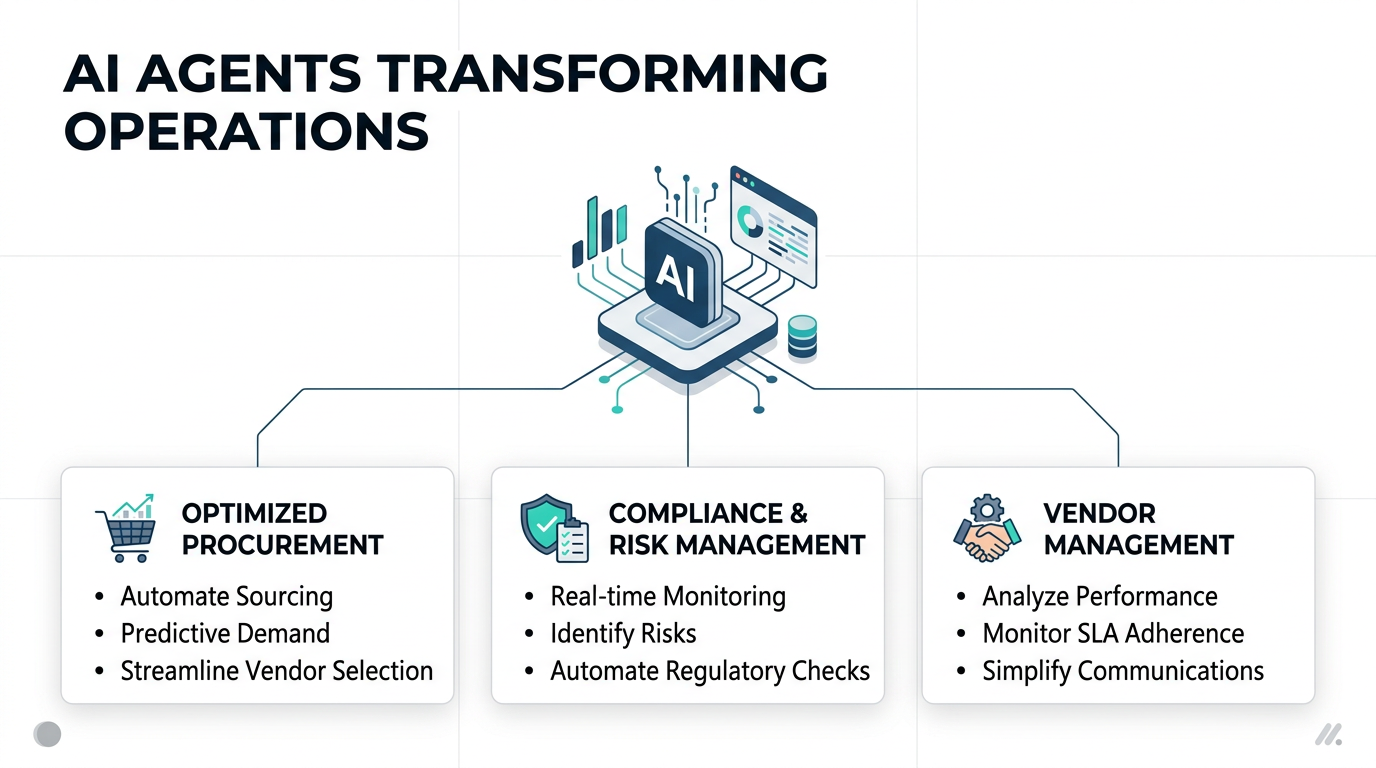
Procurement Operations
Procurement is one of the strongest use cases for agentic AI. The work is high-volume, rule-based, and data-heavy.
What the agent does:
- Monitors purchase requests and validates them against policy
- Gathers quotes from approved vendors
- Compares pricing, terms, and delivery timelines
- Generates purchase orders for approved requests
- Tracks order status and flags exceptions
- Identifies cost-saving opportunities across spend categories
Why it works: Procurement follows clear rules with well-defined exceptions. The data is structured. The integrations (ERP, vendor portals, email) are standard. An agentic system can handle 70-80% of procurement transactions without human involvement.
Current limitation: Complex negotiations, strategic vendor relationships, and non-standard contracts still need humans. The agent handles volume; humans handle nuance.
Compliance Monitoring
Compliance is tedious, critical, and poorly suited for human attention spans. Agentic AI thrives here.
What the agent does:
- Continuously monitors systems for compliance violations
- Cross-references transactions against regulatory requirements
- Generates audit-ready reports
- Flags potential violations and recommends remediation
- Tracks regulatory changes and assesses impact on current processes
Why it works: Compliance monitoring is essentially pattern matching at scale. Regulations are (mostly) clear rules. Violations are detectable in data. The agent doesn't get bored reviewing the 10,000th transaction.
Current limitation: Interpreting ambiguous regulations, making judgment calls on borderline cases, and interfacing with regulators still require human compliance officers. The agent is a force multiplier, not a replacement.
Vendor Management
Managing dozens or hundreds of vendor relationships is an operational headache that scales poorly with humans.
What the agent does:
- Tracks contract terms, renewal dates, and SLA performance
- Monitors vendor deliverables against agreed metrics
- Generates vendor scorecards and performance reviews
- Flags contracts approaching renewal with analysis and recommendations
- Manages routine vendor communications
Why it works: Vendor management is mostly data tracking and communication. The agent can monitor a hundred vendors simultaneously with consistent attention, something no human team can match.
Accounts Payable and Receivable
AP/AR is the classic high-volume, rule-based back-office function.
What the agent does:
- Processes incoming invoices (extraction, validation, matching)
- Routes approvals based on delegation of authority rules
- Generates payment batches
- Follows up on overdue receivables
- Reconciles accounts and flags discrepancies
Why it works: The transaction patterns are well-understood. Document extraction has improved dramatically. The rules are explicit. Most AP/AR work is exactly the kind of structured, repetitive work that agents handle well.
Use Cases That Are Mostly Vaporware
Not everything labeled "agentic AI" is real. Here's what vendors are selling but not delivering yet.
"Autonomous Strategy"
Any vendor claiming their AI agent can set business strategy is selling fiction. AI agents can gather data, identify patterns, and generate options. They cannot understand organizational politics, market timing, or competitive dynamics well enough to make strategic decisions.
"Creative Campaign Management"
AI can generate content and A/B test variations. It cannot develop a creative strategy, understand brand voice nuance, or make the kind of intuitive creative leaps that effective campaigns require.
"Full Autonomous HR"
AI can screen resumes, schedule interviews, and process onboarding paperwork. It cannot evaluate cultural fit, conduct meaningful interviews, or navigate the interpersonal dynamics of performance management.
The Tell
When a vendor says "fully autonomous" and "end-to-end" together, ask for a customer reference. Ask what percentage of tasks the agent handles without human intervention. Ask what the escalation rate is. The answers will reveal whether you're looking at a real product or a demo.
How to Evaluate Agentic AI Vendors
If you're considering agentic AI for your operations, here's how to separate signal from noise.
Ask These Questions
-
"What is the human-in-the-loop rate?" Any vendor who says zero is either lying or running in demo mode. Production agentic systems have escalation rates. Expect 10-30% depending on the complexity of the domain.
-
"Can I see production metrics from an existing customer?" Not demo metrics. Production. With real data volumes, real edge cases, real error rates.
-
"What happens when the agent is wrong?" Every system makes mistakes. The question is how those mistakes are caught, corrected, and prevented from recurring.
-
"How do you handle model changes?" LLMs get updated. Agent behavior can change when the underlying model changes. Good vendors have evaluation frameworks that catch regressions.
-
"What's the integration architecture?" Are they using direct API integration or screen scraping? Do they support your specific systems? How do they handle authentication and credential management?
Red Flags
- Demos that only show the happy path
- No discussion of failure modes or error handling
- Claims of "fully autonomous" without qualification
- Inability to explain the agent's decision-making process
- No audit logging or observability
Getting Started
The most successful agentic AI deployments we've seen follow a pattern:
- Pick one operation. Don't try to transform everything at once. Choose a high-volume, rule-based process with clear success metrics.
- Start semi-autonomous. Deploy with human oversight on day one. Let the agent prove itself before expanding autonomy.
- Measure relentlessly. Track accuracy, speed, cost, and escalation rate. Compare to the human baseline.
- Expand based on data. Once the first operation is running well, apply the same playbook to the next one.
At OpFleet, we deploy agentic AI operators for business operations teams. We handle the integration, monitoring, and ongoing management. You define the function; we make it run.
Ready to put agentic AI to work? Let's start with one operation →