AI Employees vs AI Chatbots: What's the Difference?
Chatbots answer questions. AI employees do work. Here's why the distinction matters and what it means for building an AI workforce.
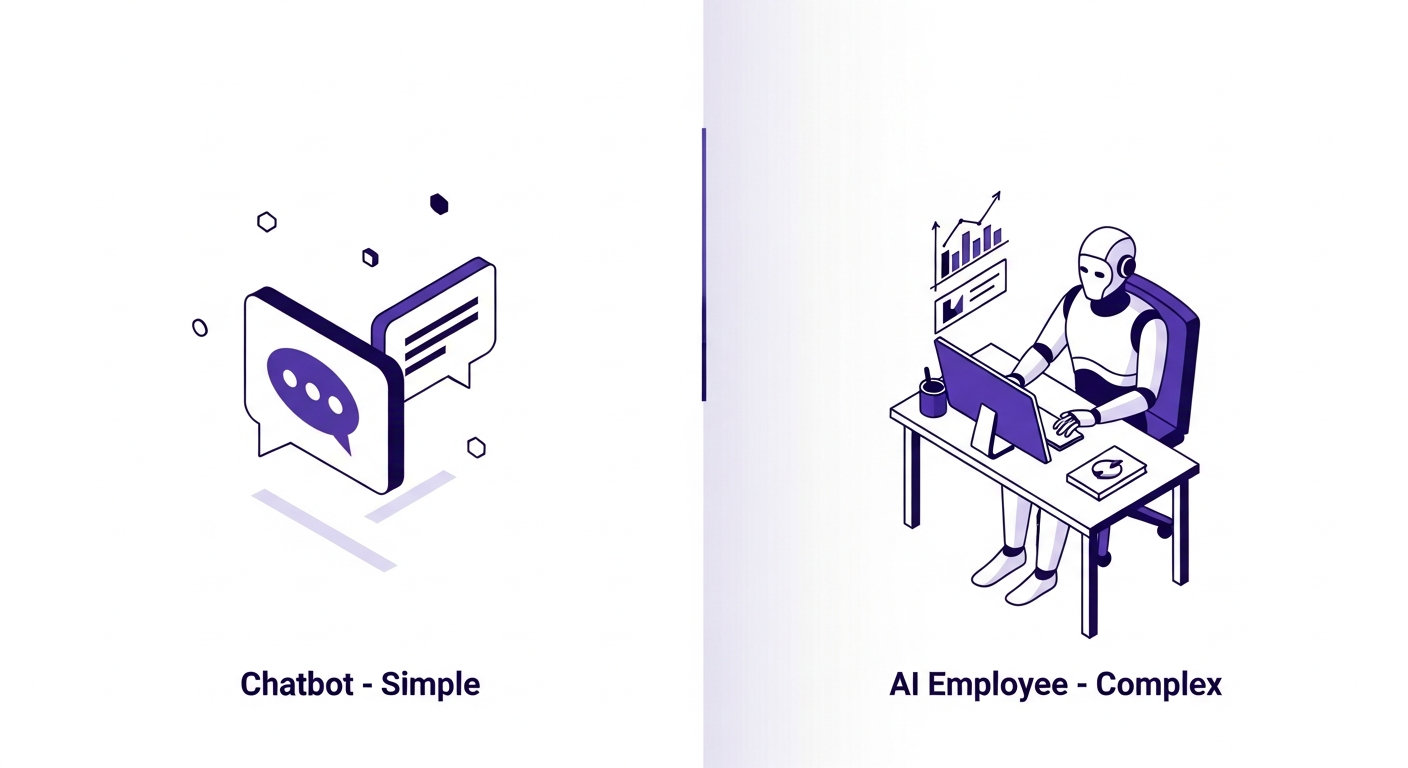
Let's get something out of the way: calling a chatbot an "AI employee" is like calling a vending machine a chef. One dispenses pre-packaged answers. The other actually cooks.
The AI industry has a branding problem. Every product with an LLM behind it calls itself an "AI agent" or "AI employee." Most of them are chatbots with better marketing. Understanding the difference isn't academic. It determines whether you'll actually get ROI from AI or just burn budget on a glorified FAQ page.
The Chatbot Mental Model
Chatbots are reactive. A user sends a message, the chatbot processes it, and it responds. That's the entire loop. Even sophisticated ones built on GPT-4 or Claude follow this pattern:
- Wait for input
- Generate a response
- Return to idle
They don't have goals. They don't manage state across interactions in any meaningful way. They don't take action in external systems. They're language interfaces, and good ones at that, but they're not workers.
Most "AI assistants" on the market today are chatbots. They can answer questions about your product, summarize documents, draft emails. Useful? Absolutely. But they require a human to initiate every interaction and decide what to do with every output.
What Makes an AI Employee Different
An AI employee, or what we call an AI operator, is fundamentally different in five ways:
1. Goal-Oriented, Not Prompt-Oriented
A chatbot responds to what you ask. An AI employee pursues objectives. You don't tell it "summarize this report." You tell it "keep me informed about competitive moves in our market" and it figures out what to monitor, how often to check, and what's worth flagging.
The difference is between giving someone directions turn by turn versus giving them a destination and letting them navigate.
2. Autonomous Action
AI employees interact with external systems. They don't just generate text; they send emails, update CRMs, create tickets, pull data from APIs, schedule meetings. They operate within your business infrastructure the way a human employee would.
A chatbot can draft an email. An AI employee drafts, sends, and follows up when there's no response after 48 hours.
3. Persistent Memory and Context
Here's where most "AI agents" fall apart. Chatbots have conversations. When the conversation ends, the context disappears. Even with conversation history, they're essentially re-reading old chat logs rather than maintaining genuine understanding.
AI employees maintain persistent memory. They remember that the Q3 board meeting was moved to October 15th. They know that your biggest client prefers communication via Slack, not email. They accumulate institutional knowledge the way human employees do, just faster.
4. Multi-Step Workflows
Ask a chatbot to "research our top 10 competitors and create a comparison matrix with pricing, features, and recent funding rounds, then email it to the leadership team." It might give you a decent first draft of the matrix. Maybe.
An AI employee breaks this into subtasks: identify competitors, research each one across multiple sources, cross-reference pricing pages, check Crunchbase for funding data, compile the matrix, format it for the audience, send it to the right people. Each step feeds the next. If a pricing page is behind a login, it flags that and moves on rather than hallucinating numbers.
5. Judgment and Escalation
This is the most underappreciated difference. AI employees make judgment calls. Not about everything, but about their domain. They know when something is routine (handle it) versus unusual (flag it) versus critical (escalate immediately).
A chatbot treats every query the same. An AI employee treats a routine status update differently than a message from your CEO differently than a potential security incident.
Why This Distinction Matters for Your Business
The chatbot vs. AI employee distinction isn't just semantic. It determines your deployment strategy, your expected ROI, and your organizational structure.
Staffing Model vs. Tool Model
You deploy chatbots like tools. You deploy AI employees like staff. The difference in approach is profound:
- Tools need someone to pick them up and use them. Their value scales with how often humans interact with them.
- Staff work independently. Their value scales with the scope of their responsibilities.
If you're evaluating AI solutions and the vendor can't explain what their product does when no human is interacting with it, you're buying a chatbot.
Cost Structure
Chatbots are typically priced per conversation or per seat. AI employees are priced for output. At OpFleet, operators start free with 100 hours/month, with self-service plans from $500/month and fully managed options from $5,000/month. Compare that to the cost of a human employee doing the same tasks, or the cost of not doing those tasks at all because nobody has the bandwidth.
The ROI math is different too. Chatbot ROI is measured in support tickets deflected. AI employee ROI is measured in work completed, decisions made, and hours returned to your human team.
The AI Workforce
Here's where it gets interesting. Once you have AI employees, and not just chatbots, you can start thinking about an AI workforce. Multiple operators with different specializations, working together, handing off tasks to each other, and escalating to humans only when necessary.
This isn't theoretical. Companies are already deploying specialized AI operators for research, content production, GTM operations, and compliance monitoring. The operators don't replace human judgment at the strategic level. They execute at the operational level so humans can focus on strategy.
The Spectrum, Not the Binary
In practice, there's a spectrum between chatbot and AI employee. Here's a rough framework:
Level 1: Basic Chatbot — Responds to questions with pre-trained knowledge. No memory, no actions, no autonomy.
Level 2: Smart Assistant — Uses RAG or tools to access current data. Can perform simple actions (search, calculate). Still reactive.
Level 3: Workflow Agent — Executes multi-step processes when triggered. Has some tool access. Limited memory between sessions.
Level 4: AI Operator — Goal-oriented with persistent memory, multi-system access, and judgment capabilities. Works autonomously within defined boundaries.
Level 5: AI Employee — Full operator capabilities plus organizational awareness, cross-functional collaboration, and progressive autonomy earned through demonstrated reliability.
Most products on the market are Level 2 calling themselves Level 4. When you're evaluating vendors, ask these questions:
- What does your AI do when no human is interacting with it?
- How does it handle multi-step workflows that span hours or days?
- What happens to context between sessions?
- Can it take actions in external systems without human approval for each one?
- How does it decide what to escalate versus handle independently?
The answers will tell you where the product actually sits on this spectrum.
Where the Industry Is Headed
The chatbot era was necessary. It proved that LLMs could be useful in business contexts. But we're past that now. The question isn't "can AI understand language?" The question is "can AI do work?"
The companies that figure out the AI employee model, genuine autonomous operators with memory, judgment, and system access, will have a structural advantage. They'll operate with smaller teams, faster response times, and 24/7 coverage across functions that currently require human attention.
The companies that keep deploying chatbots and calling them AI employees will wonder why their AI investment isn't paying off.
The distinction matters. Choose accordingly.