AI SDR vs Human SDR: The Real Comparison for Enterprise Sales
AI SDRs handle 10-50x the volume but human SDRs generate 2.6x more revenue. Here's why the best enterprise teams deploy both, and how managed AI employees bridge the gap.
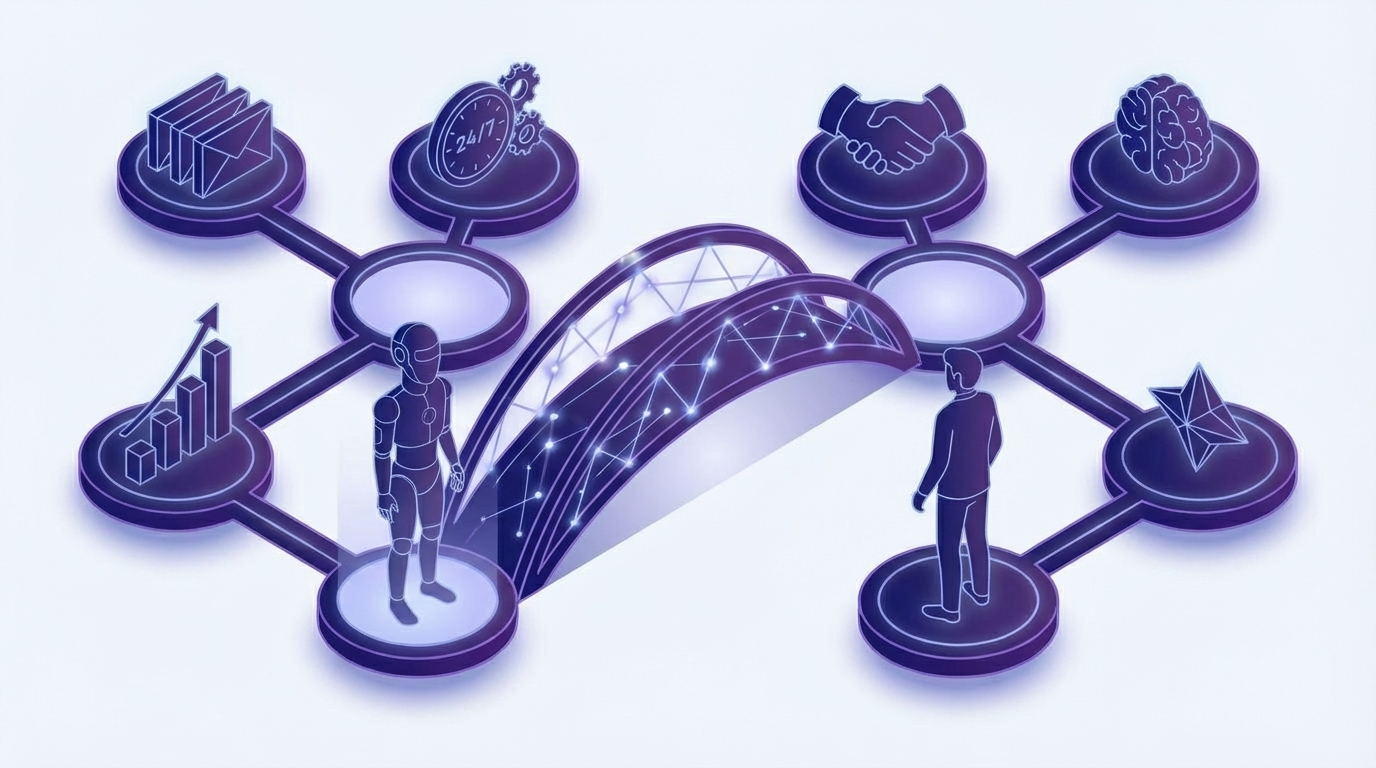
The "AI SDR vs human SDR" debate is framed wrong. It assumes you have to pick one. The data from 2025 and early 2026 tells a different story: the teams generating the most pipeline are running both, but not the way most people think.
Let's look at what actually works, what doesn't, and where the industry is headed.
The Numbers Nobody Wants to Talk About
AI SDRs can send 500-5,000 personalized emails per day. A human SDR manages 50-100. On raw activity, AI wins by an order of magnitude.
But activity is not pipeline.
In controlled comparisons, human SDRs generated $147,000 in revenue versus $56,000 for AI SDRs operating on the same accounts. Meeting show rates: 71% for human-booked versus 52% for AI-booked. Meeting-to-opportunity conversion: 25-40% for human versus 10-20% for AI.
More meetings, worse meetings. That is the current state of autonomous AI SDRs. For some sales motions, the volume makes up for the quality gap. For enterprise sales, it does not.
Where AI SDRs Win
Dismissing AI SDRs entirely would be a mistake. They dominate specific functions:
Speed to first touch. When a prospect downloads a whitepaper at 11 PM on a Tuesday, an AI SDR can respond in seconds with relevant context. A human SDR responds the next morning, if they remember. Speed to lead correlates directly with conversion rates, and AI wins this one conclusively.
Follow-up consistency. The most common SDR failure is not bad outreach. It is no outreach. Leads slip through cracks. Follow-ups get missed. Sequences break down during busy weeks. AI never forgets. Every prospect gets every touch at the right time.
Pattern recognition. AI processes engagement data across thousands of interactions and identifies which subject lines, send times, message structures, and value propositions drive the highest response rates. A human SDR has intuition built from dozens of interactions. AI has signal built from thousands.
Multi-timezone coverage. Enterprise prospects span the globe. Staffing human SDRs across every timezone is expensive. AI operates around the clock, sending outreach in the recipient's optimal window regardless of where your team sits.
Data hygiene. AI SDRs update CRM records, log activities, capture notes, and maintain pipeline accuracy as a byproduct of their work. Human SDRs treat CRM updates as a chore. Most sales leaders spend significant time chasing reps for data that AI captures automatically.
Where Human SDRs Win
Human advantages are harder to quantify but they show up clearly in the revenue numbers:
Strategic account research. An AI SDR pulls firmographic data and recent news. A human SDR reads between the lines of an earnings call, notices that a company's new CTO came from a competitor that uses your product, and crafts an approach based on that specific angle. The depth of insight is fundamentally different.
Relationship development. Enterprise deals involve multiple stakeholders with different priorities. Building trust across a buying committee requires empathy, adaptability, and social intelligence that AI does not have. A human SDR who develops a genuine relationship with a champion can navigate internal politics in ways that no AI outreach can replicate.
Complex objection handling. When a senior buyer responds with a nuanced objection that mixes budget concerns with technical requirements and political dynamics, a human SDR reads the subtext. AI treats it as a text classification problem and responds with the closest template match.
Creative problem solving. Sometimes the best move is not an email. It is a warm introduction through a mutual connection, a thoughtful LinkedIn comment on the prospect's recent post, a relevant case study sent with no ask attached, or a phone call. Human SDRs adapt their approach. AI SDRs optimize within their configured channels.
Brand representation. Your SDR is often the first human interaction a prospect has with your company. That interaction sets the tone for the entire relationship. AI-generated outreach, no matter how well-crafted, lacks the authenticity signal that a real human provides.
The Hybrid Model That Actually Works
Forty-five percent of sales teams have already adopted some form of AI-augmented SDR workflow. But most are doing it wrong. They bolt an AI tool onto their existing process and hope for improvement. The result is usually more activity with the same (or worse) outcomes.
The model that produces results looks different:
AI handles the operating system
Research, data enrichment, signal monitoring, sequence management, initial outreach, follow-up cadence, CRM updates, and pipeline reporting. These are operational tasks that consume 60-70% of a human SDR's day. AI does them faster, more consistently, and at higher volume.
Humans handle the moments that matter
Responding to engaged prospects. Navigating complex objections. Building relationships with key accounts. Making strategic decisions about which accounts to prioritize and how to approach them. Adding the personal context and authenticity that converts interest into pipeline.
The handoff is the hardest part
The critical element most teams get wrong is the transition from AI to human. A prospect who has been engaged by AI and then handed to a human who asks the same questions or ignores the conversation history will disengage immediately.
Effective handoffs require:
- Full context transfer. The human rep sees every interaction, every signal, and every piece of account intelligence the AI has gathered.
- Seamless continuity. The prospect should not feel a jarring shift in communication style or knowledge level.
- Strategic briefing. Not just "this person replied." A recommended approach based on the prospect's engagement patterns, likely objections, and competitive context.
Why Managed AI Employees Bridge the Gap
Most AI SDR tools put the burden of making the hybrid model work on you. You configure the AI, train it on your messaging, build the handoff workflows, monitor output quality, and troubleshoot when things break. You are simultaneously running sales and running an AI operations team.
Managed AI employees flip that model. The AI SDR operates as a staffed role with built-in oversight:
Professional configuration. The AI SDR is onboarded to your market, your ICP, your competitive landscape, and your existing messaging. It does not start from a generic template.
Continuous quality management. An operations layer monitors output quality, response rates, and meeting conversion. When performance dips, the AI's approach is adjusted proactively, not after you notice a problem weeks later.
Intelligent escalation. The AI SDR assesses conversation complexity and routes to human reps with full context briefings. The human rep walks into every conversation prepared.
Persistent memory. The AI SDR builds institutional knowledge over time. It remembers account history, past interactions, competitive dynamics, and what has worked for similar prospects. This compounding context is what separates a managed employee from a stateless tool.
Making the Decision
The right approach depends on your sales motion:
High-volume SMB with short cycles (< 30 days). AI SDRs can handle most of the workflow autonomously. The volume advantage outweighs the quality gap when deal sizes are small and buying processes are simple.
Mid-market with moderate complexity (30-90 day cycles). Hybrid model with AI handling research, outreach, and follow-ups while humans handle engaged prospects and complex conversations. This is where managed AI employees deliver the strongest ROI.
Enterprise with long cycles (90+ days). Human SDRs remain essential for strategic account development. AI augments their research and handles operational tasks, but the relationship building and strategic thinking cannot be automated. Managed AI employees handle the high-volume layers of the funnel while human reps focus on the accounts that matter most.
What to Measure
If you deploy AI SDRs (managed or DIY), track these metrics alongside your human SDR benchmarks:
- Meeting show rate (not just meetings booked). AI SDRs often inflate meeting counts with low-quality bookings.
- Meeting-to-opportunity conversion. This reveals whether AI-sourced meetings have genuine buying intent.
- Average deal size from AI-sourced pipeline. Watch for downward drift, which indicates the AI is booking meetings with the wrong prospects.
- Human rep time saved. The primary value of an AI SDR in a hybrid model is freeing human reps for high-value activities. If your reps are spending the same amount of time on operational tasks, the AI is not working.
- Response sentiment. Track not just response rates but response quality. Are prospects engaging positively or asking to be removed?
Where This Is Headed
The AI SDR market will consolidate. Fully autonomous "replace your SDR team" tools will settle into niche use cases (high-volume SMB outbound). The mainstream will move toward managed AI employees operating alongside human sales teams.
The companies that figure out the human-AI handoff first will build a durable competitive advantage. Not because the AI is better (the underlying models are increasingly commoditized) but because the orchestration of AI capability with human judgment creates outcomes that neither can achieve alone.
At OpFleet, we are building for that future. Managed AI employees that start productive on day one, improve continuously, and make your human reps measurably more effective.
If you are weighing the AI SDR decision for your team, let's talk specifics.