Managed AI Agents vs DIY: The Build-or-Buy Decision Framework
A decision framework for choosing between building your own AI agents and using a managed service. When DIY makes sense, when managed wins, and how to evaluate the tradeoffs.
You've decided your team needs AI agents. Now comes the question that every engineering leader asks: do we build it ourselves or buy a managed solution?
The answer depends on factors that most build-vs-buy frameworks ignore. Traditional frameworks focus on cost and timeline. With AI agents, the critical factors are talent, maintenance burden, and how far from your core business the work actually is. We've seen companies make both decisions well and both decisions badly. Here's how to get it right.
The DIY Case
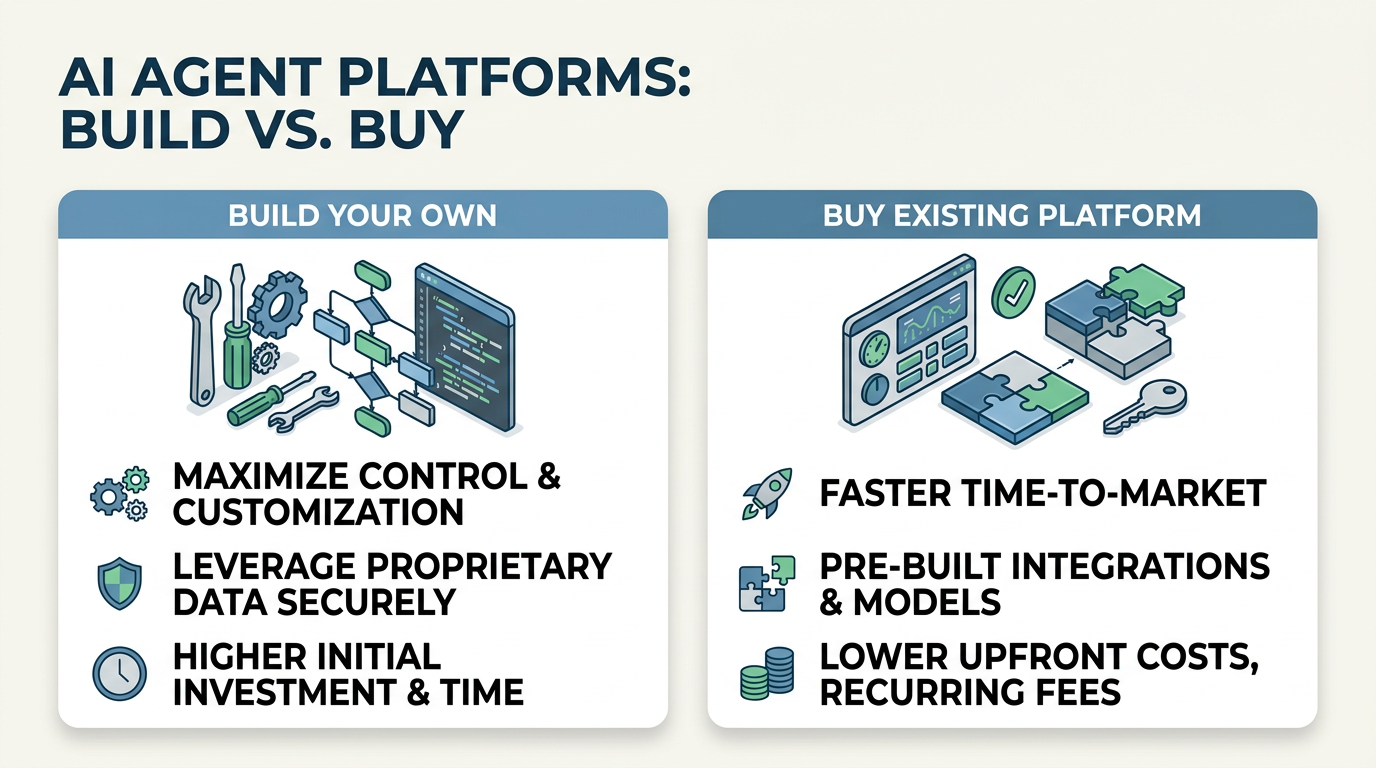
Building your own AI agents gives you maximum control. You pick the models, design the architecture, define the guardrails, and own the entire stack. For some organizations, this is the right call.
When DIY Makes Sense
You have ML engineering talent on staff. Not data scientists who can train models. ML engineers who can build production systems: prompt engineering, evaluation frameworks, tool integration, monitoring, and incident response. If you have three or more ML engineers with production experience, DIY becomes viable.
Your workflows are genuinely unique. If your business processes are truly differentiated and competitive advantage depends on how they work, a custom solution can capture that differentiation. A hedge fund's trading analysis workflow is unique. A company's expense report processing is not.
You're an AI company. If AI is your product, building your own agent infrastructure is a core competency investment. You should be building this regardless.
Regulatory requirements demand it. Some industries require on-premise deployment, specific data residency, or audit capabilities that managed services don't yet support. In these cases, DIY may be the only option.
The Hidden Costs of DIY
Most teams underestimate DIY costs by 3-5x. Here's what they miss:
Ongoing maintenance. Models change. APIs break. New attack vectors emerge. The agent you built in Q1 needs updates in Q2, Q3, and Q4. This isn't a build-once-and-forget project. Budget 40-60% of the initial build cost annually for maintenance.
Evaluation infrastructure. You need a way to test your agents before deploying changes. That means building eval suites, maintaining test data, running benchmarks, and tracking performance over time. This is an entire system unto itself.
Monitoring and observability. Production AI agents need monitoring that goes beyond uptime checks. You need to track output quality, detect behavioral drift, log actions for audit, and alert on anomalies. Building this from scratch is a multi-month effort.
Security. Prompt injection defenses, credential management, access controls, audit logging. Each of these is a project. Together, they're a program.
Talent retention. ML engineers are in high demand. The people who build your system might leave. If the system is custom and poorly documented (as custom systems often are), you're in trouble.
The Managed Case
Managed AI agent services handle the infrastructure, deployment, monitoring, and maintenance. You define the role; they deploy the agent. Your team focuses on outcomes rather than infrastructure.
When Managed Wins
Speed matters. A managed service can deploy a production AI agent in days. Building the same capability from scratch takes months. If you need results this quarter, not next year, managed is the practical choice.
You're not an AI company. If AI agents are a tool for your business rather than your business itself, the build-vs-buy calculus shifts heavily toward buy. You don't build your own email server. You probably shouldn't build your own AI agent infrastructure.
Your team is small. If you have fewer than three ML engineers, the maintenance burden of a DIY solution will consume them. They'll spend their time keeping the lights on instead of improving the system.
Reliability is non-negotiable. Managed services have SLAs, on-call teams, and incident response processes. Your DIY solution has whoever built it, assuming they're still at the company and not on vacation.
You want to start with proven patterns. Managed services have deployed agents for dozens of customers. They know what works, what fails, and how to handle edge cases. You're buying their experience, not just their software.
Concerns About Managed Services
Let's address the objections head-on.
"We'll lose control." Valid concern, but manageable. Look for services that give you control over prompts, guardrails, and data access policies. You should own the role definition even if someone else handles the infrastructure.
"It's more expensive." In the short term, maybe. In the medium term, almost certainly not. Factor in the fully loaded cost of ML engineers, infrastructure, maintenance, and opportunity cost. Most teams find that DIY is significantly more expensive over a two-year horizon.
"Vendor lock-in." Real risk. Mitigate it by choosing services that use standard interfaces, allow data export, and don't lock your configurations into proprietary formats. Ask about exit clauses before you sign.
"Security concerns." Fair. Evaluate the vendor's security posture, data handling practices, compliance certifications, and incident history. A good managed service invests more in security than most internal teams can justify.
The Decision Framework
Answer these five questions honestly:
1. Is AI agent development a core competency for your business?
If yes → DIY. If no → Managed.
Most companies answer "no" here. Building AI agents is a means to an end, not the end itself.
2. Do you have the talent to build AND maintain?
Building is the fun part. Everyone focuses on the build. But agents need continuous maintenance: model updates, prompt tuning, security patches, eval suite updates, monitoring improvements. Do you have the team for that ongoing work?
If you can staff 2-3 dedicated ML engineers for the long term → DIY is viable. If not → Managed.
3. How unique are your requirements?
Be honest. Most business processes are less unique than people think. Customer support, data entry, document processing, compliance monitoring. These are well-understood domains with established patterns.
If your requirements are truly unique and competitively differentiated → DIY. If they're standard business processes with custom configuration → Managed.
4. What's your timeline?
DIY: 3-6 months to initial deployment, 6-12 months to production-grade. Managed: days to weeks.
If you need results in under 3 months → Managed. If you can wait → either could work.
5. What's your risk tolerance?
DIY means you own all the risk. If the agent makes a mistake, you debug it. If there's a security incident, you respond to it. Managed services share that risk with you.
If you have mature incident response and on-call processes → DIY is manageable. If not → Managed.
The Hybrid Approach
It's not always binary. Some organizations start with managed services for immediate needs and build custom solutions for genuinely unique workflows. This gives you speed where you need it and differentiation where it matters.
The key is being honest about which bucket each use case falls into. Support ticket triage is probably not your competitive advantage. Your proprietary underwriting algorithm might be.
Making the Decision
Here's the uncomfortable truth: most companies that choose DIY do so for emotional reasons, not rational ones. Engineering teams want to build. Leaders want to own the stack. There's a bias toward custom solutions that feels like strategic investment but often turns into strategic distraction.
The rational framework is straightforward. If AI agents are your core business, build. If they're a tool for your business, buy. If you're not sure, start with managed and migrate to DIY later if you outgrow it. The reverse migration is much harder.
At OpFleet, we deploy managed AI operators that give you control over the role definition, guardrails, and data policies while we handle the infrastructure, security, and ongoing maintenance. You get production-grade agents without building a production-grade platform.