What is an AI Operator? The Complete Guide
Everything you need to know about AI operators: what they are, how they work, how they differ from AI agents and chatbots, autonomy levels, and real-world use cases.
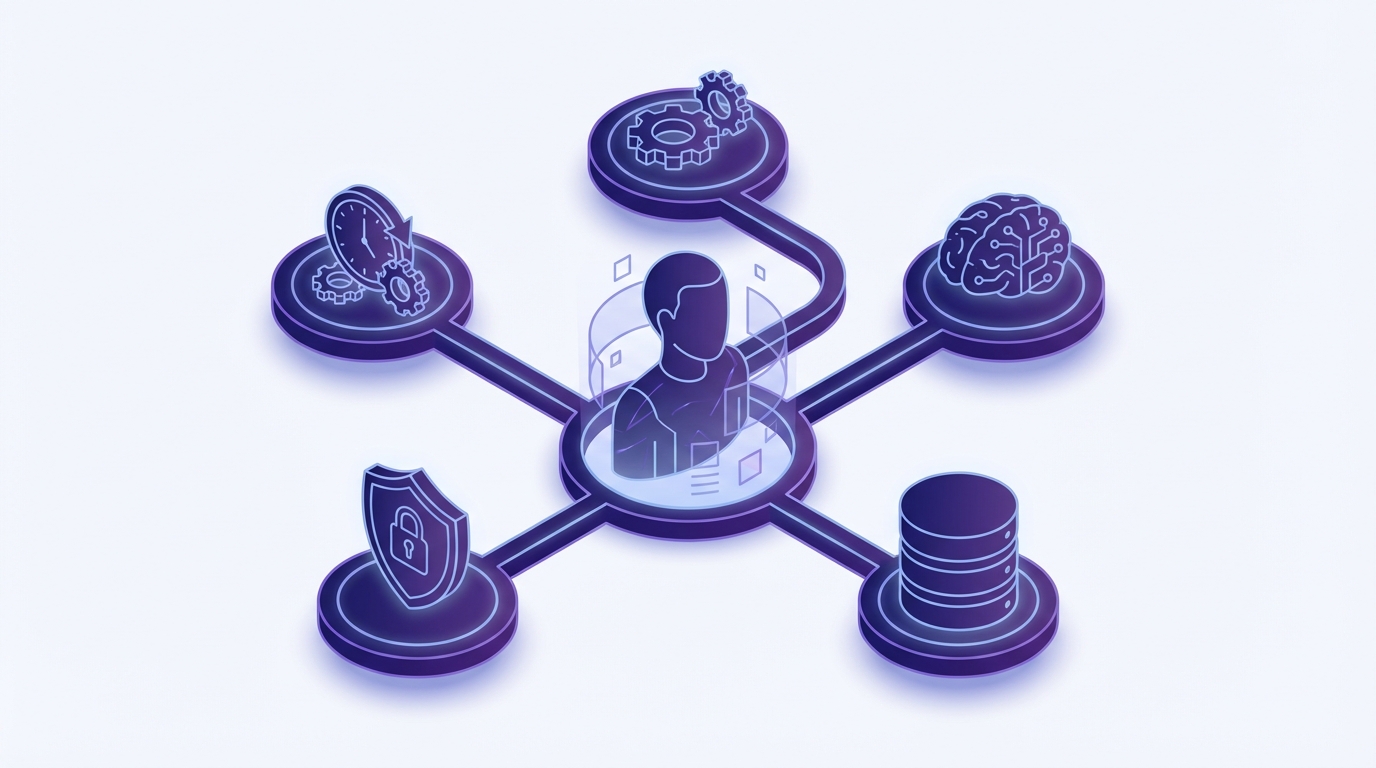
The term "AI agent" has been stretched to meaninglessness. It covers everything from a chatbot that answers FAQ questions to an autonomous system that manages entire business workflows. When everything is an AI agent, nothing is.
That's why we use the term AI operator. It's more specific, more honest, and more useful for understanding what these systems actually do. This guide covers everything: definitions, architecture, how operators differ from agents and chatbots, autonomy levels, and practical use cases.
Definition: What is an AI Operator?
An AI operator is an autonomous AI system designed to perform ongoing business functions with minimal human supervision. Unlike chatbots (which respond to queries) or simple agents (which execute single tasks), operators manage continuous responsibilities the way a human employee would.
Three properties distinguish an operator from other AI systems:
-
Continuity. Operators maintain persistent state, memory, and context across interactions. They don't start fresh every conversation. They accumulate knowledge and build on past work.
-
Agency. Operators take actions in external systems: sending emails, updating databases, creating documents, interacting with APIs. They don't just generate text; they do work.
-
Judgment. Operators make decisions within their domain. They assess priority, determine appropriate actions, and escalate when situations exceed their authority. They don't require human approval for every step.
If a system lacks any of these three properties, it's not an operator. It might be a useful tool, but it's not performing the role of an employee.
AI Operator vs. AI Agent vs. AI Chatbot
These terms get confused constantly. Here's the taxonomy:
AI Chatbot
- Interaction model: Request-response
- Memory: Session-based (forgets between conversations)
- Actions: None or very limited (can search, maybe call one API)
- Autonomy: Zero. Waits for human input, responds, waits again
- Best analogy: A reference librarian. Answers questions when asked
AI Agent
- Interaction model: Task-based
- Memory: Limited persistence (may remember some context)
- Actions: Can use tools and APIs for specific tasks
- Autonomy: Task-level. Completes assigned tasks, then stops
- Best analogy: A freelancer. Does the job you assign, delivers results
AI Operator
- Interaction model: Role-based
- Memory: Full persistence with structured knowledge management
- Actions: Comprehensive system access within defined boundaries
- Autonomy: Function-level. Manages ongoing responsibilities independently
- Best analogy: An employee. Owns a function, makes decisions, works continuously
The progression is clear: chatbots answer, agents execute, operators manage.
How AI Operators Work: The Architecture
Understanding how operators work requires looking at five architectural layers.
Layer 1: The Reasoning Core
At the center of every operator is a large language model (or ensemble of models) that handles reasoning, planning, and natural language understanding. This is the "brain." But unlike a standalone LLM, the operator's reasoning core is connected to persistent systems that give it capabilities beyond text generation.
The reasoning core handles:
- Breaking down objectives into subtasks
- Planning multi-step workflows
- Making judgment calls about priority and approach
- Generating natural language for communication
- Interpreting ambiguous instructions
Layer 2: Memory Systems
This is where operators fundamentally diverge from chatbots and basic agents. Operators use multiple memory systems:
Working memory: The current context window. What the operator is actively thinking about right now. This is analogous to human working memory, limited in capacity but fast.
Episodic memory: Records of past interactions, decisions, and outcomes. The operator can recall what happened in previous sessions, what worked, what didn't, and why certain decisions were made.
Semantic memory: Structured knowledge about the domain, the organization, key people, processes, and preferences. This is the operator's institutional knowledge.
Procedural memory: Learned workflows and patterns. How to handle specific types of requests, which tools to use for which tasks, and what steps to follow for recurring processes.
Effective memory management is arguably the hardest technical challenge in building operators. It's not enough to store everything; the operator needs to retrieve the right information at the right time and forget (or deprioritize) what's no longer relevant.
Layer 3: Tool Integration
Operators interact with the world through tools. A well-equipped operator might have access to:
- Communication: Email, Slack, Teams, calendar
- Data: CRM, databases, analytics platforms, spreadsheets
- Content: Document creation, design tools, CMS
- Development: Code repositories, CI/CD, monitoring
- Research: Web search, news APIs, social media, industry databases
Each tool integration includes authentication, error handling, rate limiting, and schema management. The operator needs to know not just how to use each tool, but when to use which tool, and how to combine them for complex workflows.
Layer 4: Orchestration
When an operator manages complex workflows, orchestration coordinates the sequence:
- Task decomposition: Breaking objectives into executable steps
- Dependency management: Understanding which steps depend on others
- Parallel execution: Running independent tasks simultaneously
- Error recovery: Handling failures gracefully without losing progress
- State management: Tracking where things stand across multi-step workflows
Orchestration is what allows an operator to handle a request like "prepare the quarterly business review" which might involve pulling data from six systems, generating charts, writing an executive summary, creating a slide deck, and distributing it to stakeholders.
Layer 5: Governance and Safety
This layer defines what the operator can and cannot do:
- Permission boundaries: Which systems can it access? What actions can it take? What's off-limits?
- Escalation rules: When must it involve a human? What thresholds trigger escalation?
- Audit trails: Complete logging of all actions, decisions, and reasoning
- Quality controls: Output validation, fact-checking, consistency checks
- Rate limits: Preventing runaway actions or excessive resource consumption
Governance isn't an afterthought. It's architectural. An operator without proper governance is a liability, not an asset.
Autonomy Levels: The Trust Ladder
Not every operator runs at full autonomy from day one. Nor should it. At OpFleet, we use a progressive autonomy model with five levels:
Level 1: Observer
The operator monitors workflows, reads data, and builds understanding. It doesn't take any actions. Think of it as a new hire's first week: learning the environment before touching anything.
Use case: Deploy a new operator in Observer mode for 1-2 weeks. Let it learn your workflows, communication patterns, and data structures. Review its observations to verify understanding.
Level 2: Advisor
The operator analyzes situations and recommends actions, but a human makes every decision. It's essentially a smart briefing system that says "here's what I'd do and why."
Use case: A research operator that surfaces competitive intelligence with recommended responses, but waits for human approval before taking action.
Level 3: Executor
The operator handles routine tasks autonomously and escalates non-routine situations. This is where most operators spend the majority of their time. Clear boundaries define what's routine (handle it) versus what requires approval (flag it).
Use case: A GTM operator that automatically sends follow-up emails on established templates but escalates custom pricing requests to a human.
Level 4: Manager
The operator makes judgment calls within its domain, handles exceptions, and coordinates with other systems or operators. Human oversight shifts from approving individual actions to reviewing outcomes and adjusting strategy.
Use case: An operations operator that independently identifies process bottlenecks, implements fixes, and reports results. Humans review weekly performance summaries rather than approving daily actions.
Level 5: Director
The operator operates with full autonomy within its function. It sets its own priorities, adapts to changing conditions, and involves humans only for strategic decisions or situations that genuinely require human judgment.
Use case: A compliance operator that independently monitors regulatory changes, updates internal policies, adjusts processes, and only escalates truly novel regulatory challenges.
Earning Trust
The key word is progressive. Operators earn higher autonomy levels through demonstrated reliability. An operator that makes consistently good decisions at Level 3 earns the trust to operate at Level 4. One that makes errors stays at its current level until the issues are resolved.
This mirrors how you'd manage a human employee. You don't give a new hire full authority on day one. You give them increasing responsibility as they prove their competence.
Real-World Use Cases
Research and Intelligence
- Competitive monitoring and analysis
- Market research and trend identification
- Customer sentiment analysis
- Patent and IP landscape tracking
- Regulatory change monitoring
Go-to-Market
- Lead research and qualification
- Personalized outbound sequences
- CRM maintenance and pipeline management
- Sales enablement and meeting prep
- Win/loss analysis
Content and Communications
- Blog posts, whitepapers, and thought leadership
- Social media management
- Internal communications
- Documentation maintenance
- Email campaign management
Operations
- Report generation and distribution
- Process monitoring and alerting
- Vendor management
- Cross-functional coordination
- Knowledge base maintenance
Compliance and Risk
- Regulatory monitoring
- Policy documentation
- Audit preparation
- Training compliance tracking
- Risk assessment and reporting
Common Misconceptions
"AI operators will replace all human workers." No. Operators handle operational execution so humans can focus on strategy, relationships, and creative work. The companies deploying operators aren't firing people; they're amplifying their existing teams.
"AI operators are just fancy chatbots." The architectural differences are fundamental. Persistent memory, autonomous action, judgment, and continuous operation aren't incremental improvements on a chatbot. They're a different category of system.
"You need to be a large enterprise to benefit." Some of the most impactful operator deployments are at companies with 20-200 employees, where every person wears multiple hats and the leverage from AI operators is enormous.
"AI operators are unreliable." The progressive autonomy model exists precisely because trust is earned. You don't give an operator full autonomy until it's proven reliable at lower levels. Well-designed operators are more consistent than humans at routine tasks.
"Building AI operators is easy." The demo is easy. Production is hard. Memory management, tool integration, orchestration, governance, evaluation: each is a deep engineering challenge. This is why managed platforms exist, so you can deploy operators without building the infrastructure from scratch.
Getting Started with AI Operators
If you're evaluating AI operators for your organization, here's a practical framework:
-
Identify the role, not the task. Don't think about "what tasks can AI do?" Think about "which roles in my organization are primarily operational?" Those are your operator candidates.
-
Start with one operator. Pick the role with the clearest operational component and the lowest risk. Research Analyst is usually the best starting point.
-
Deploy at Level 2 (Advisor). Let the operator observe and recommend before it acts. This builds confidence and surfaces any misalignments early.
-
Measure ruthlessly. Hours saved, quality of output, speed of delivery, error rate. Opinions are nice; data is better.
-
Expand deliberately. Once the first operator proves its value, add the next. Each deployment is faster than the last because your team has learned the pattern.
The companies that will thrive in the next decade aren't the ones with the most AI technology. They're the ones that figure out how to deploy AI as a genuine workforce multiplier, not as a flashy demo, but as reliable operators that do real work, every day, at every level of the organization.
That's what AI operators are. Not chatbots with a new name. Not agents with better marketing. A new category of business capability that changes how work gets done.