What Is an AI SDR? The Managed AI Employee Approach
AI SDRs promise to automate sales development. Most fail because they treat it as a software problem. Here's why the managed AI employee model works where DIY SDR bots don't.
The AI SDR market exploded in 2025. By early 2026, the results are in: fully autonomous AI SDRs have not replaced human sales teams at any meaningful scale. Companies that deployed tools like Artisan, 11x.ai, and AiSDR as full SDR replacements have largely reverted to hybrid models.
The problem is not the technology. The problem is the deployment model. Most AI SDR tools treat sales development as a software configuration problem. Drop in a tool, feed it your ICP, let it rip. That approach fails for the same reason you would not hand a new hire a laptop on day one and expect pipeline by day two.
Sales development is an employee problem. It requires onboarding, context, judgment, memory, and continuous improvement. That is exactly what a managed AI employee delivers.
What an AI SDR Actually Does
An AI SDR automates the core functions of a human sales development representative: identifying prospects, researching accounts, writing personalized outreach, managing follow-up sequences, qualifying responses, and booking meetings.
The scope varies by tool, but most cover these areas:
Prospecting and research. Identifying target accounts and contacts that match your ideal customer profile. Pulling firmographic data, recent news, hiring signals, and technology stack information.
Outreach drafting. Writing personalized emails, LinkedIn messages, and follow-up sequences tailored to each prospect's context.
Sequence management. Sending messages on schedule, tracking opens and replies, adjusting timing based on engagement signals.
Reply handling. Classifying responses (interested, objection, not now, unsubscribe) and routing them appropriately. Responding to simple questions. Escalating complex conversations to humans.
Meeting booking. Qualifying interested prospects against your criteria and scheduling calls with the right sales rep.
The technology to do all of this exists today. What separates success from failure is execution.
Why Most AI SDR Deployments Fail
The data paints a clear picture. Human SDRs generate 2.6x more revenue ($147K vs $56K in head-to-head comparisons) and achieve 71% meeting show rates compared to 52% for AI. AI SDRs book more meetings in absolute terms but with significantly lower quality.
Three failure modes dominate:
1. The Generic Outreach Problem
AI SDRs personalize from LinkedIn profiles and company descriptions. They miss earnings call language, hiring patterns, competitive dynamics, and strategic signals that make outreach actually relevant. When a prospect receives an email that references their job title and company name but nothing about their actual challenges, they recognize it as automated and delete it.
The fix is not better prompting. It is deeper context. An AI SDR needs to understand your market, your competitive positioning, your customer's buying triggers, and how your solution maps to their specific situation. That understanding does not come from a configuration wizard.
2. The Judgment Gap
When a VP of Sales at a Fortune 500 company replies with a nuanced objection about deployment timelines, a typical AI SDR produces a generic response that damages credibility. Enterprise selling requires reading between the lines, knowing when to push and when to back off, understanding organizational politics, and recognizing buying signals that are not explicit.
Current AI SDR tools handle this with rule-based escalation: if the prospect mentions pricing, route to a human. That is a band-aid on a structural problem. Real judgment comes from context accumulation over time, not static rules.
3. The Ramp Problem
Every AI SDR vendor promises "days to weeks" for setup. What they mean is days to configure the software. Actual productive output takes much longer because the AI needs to learn your voice, your market, your objection handling, your competitive positioning, and your qualification criteria.
DIY tools put that entire learning burden on you. You are simultaneously the AI trainer, the quality auditor, the strategy designer, and the person trying to close deals. Most sales leaders do not have 20 hours a week to babysit an AI tool.
The Managed AI Employee Model
OpFleet approaches AI SDRs differently. Instead of selling software, we deploy managed AI employees.
The distinction matters. A managed AI employee comes with:
Professional onboarding. We do not hand you a tool and wish you luck. We study your market, your ICP, your competitive landscape, your sales process, and your existing messaging. The AI SDR starts with real context, not a blank slate.
Persistent memory. Every interaction, every response, every piece of feedback accumulates as institutional knowledge. The AI SDR does not start fresh every day. It remembers that your biggest prospect prefers concise emails, that your competitor just raised a Series C, and that your product's deployment timeline shortened last quarter.
Continuous tuning. A dedicated operations layer monitors output quality, adjusts strategy based on response patterns, and improves the AI's judgment over time. This is not a set-it-and-forget-it tool. It is a managed service that gets better every week.
Human escalation with context. When a conversation requires human judgment, the handoff includes full context: what was said, what the AI assessed about the prospect's interest level, what competitive dynamics are at play, and a recommended next action. Your sales rep does not start from zero.
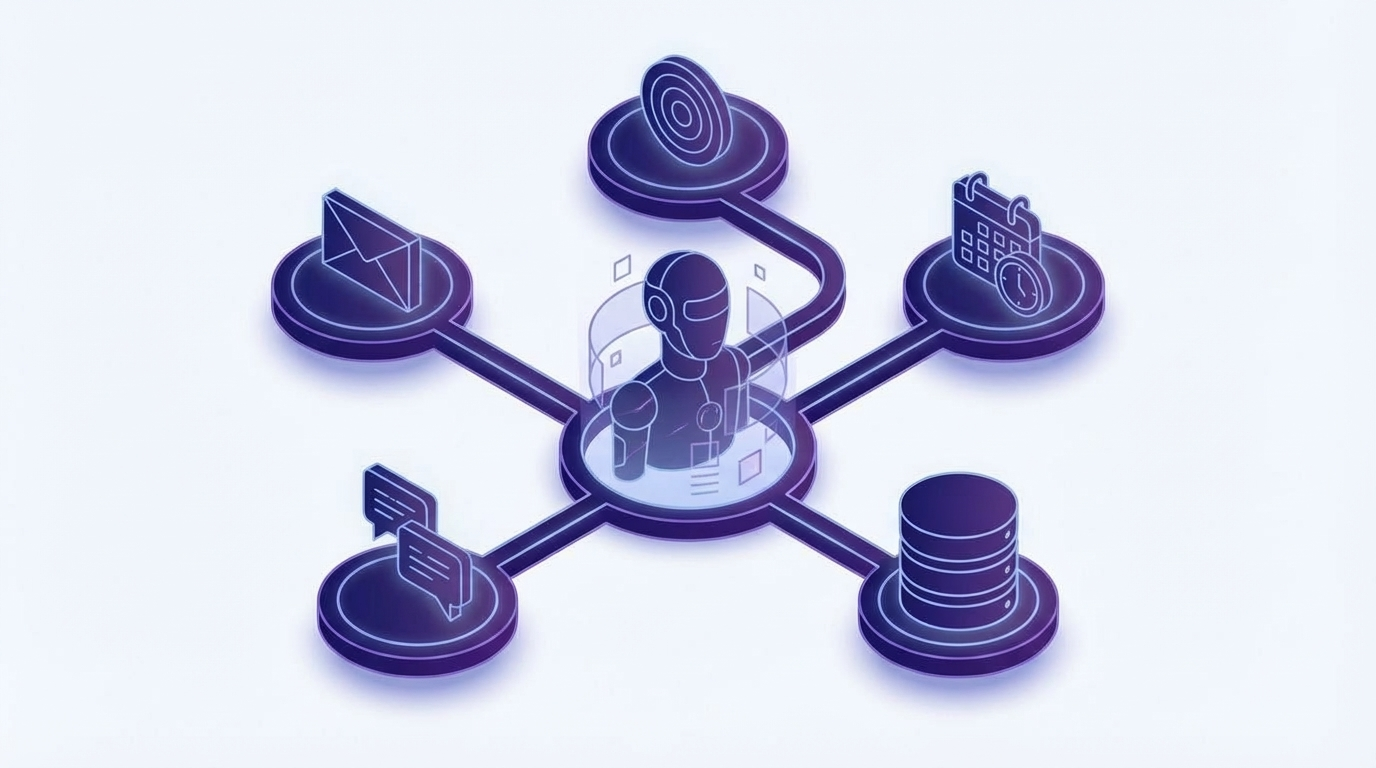
Multi-system integration. The AI SDR operates within your existing stack: CRM, email, LinkedIn, calendar, and internal communication tools. It does not live in its own silo.
What This Looks Like in Practice
An OpFleet AI SDR's typical day:
6:00 AM. Scans overnight buying signals: new job postings matching your ICP, funding announcements, technology adoption signals, competitor mentions in earnings calls.
7:00 AM. Prioritizes today's outreach list based on signal strength and account scoring. Drafts personalized messages that reference specific, timely triggers for each prospect.
8:00 AM - 12:00 PM. Sends outreach in time-zone-appropriate windows. Monitors for responses. Handles routine replies (scheduling questions, basic product inquiries) autonomously.
12:00 PM - 5:00 PM. Manages follow-up sequences. Adjusts timing based on engagement. Escalates promising conversations to human reps with full context briefs.
5:00 PM. Generates a daily pipeline report: messages sent, responses received, meetings booked, key accounts to watch, recommended strategy adjustments.
This is not a software tool running in the background. It is a managed employee performing a job, with oversight, quality controls, and continuous improvement built in.
The Economics
Human SDRs cost $100,000-150,000 per year fully loaded (salary, benefits, tools, management overhead, ramp time). Turnover averages 35% annually, meaning you lose institutional knowledge regularly and spend months ramping replacements.
DIY AI SDR tools cost $12,000-60,000 per year in licensing. But add in the hidden costs: your time configuring and tuning, the opportunity cost of poor-quality outreach during the learning period, and the engineering resources needed for integration. The true cost often approaches a human SDR without the output quality.
A managed AI SDR employee sits between these extremes. Lower total cost than a human SDR. Higher output quality than a DIY tool. No turnover. No ramp time lost to institutional knowledge drain.
The math becomes compelling at scale. Five human SDRs cost $500,000-750,000 per year. Five managed AI SDR employees cost significantly less while maintaining consistent quality across all accounts.
When to Choose What
Choose a human SDR when your sales motion requires deep relationship building with a small number of strategic accounts, when your product requires complex technical discovery that changes with every prospect, or when your market is small enough that every prospect knows every rep.
Choose a DIY AI SDR tool when you have dedicated sales operations resources to configure and maintain it, when your product has a straightforward value proposition with minimal objection handling, or when you are targeting high-volume SMB accounts with short sales cycles.
Choose a managed AI SDR employee when you want enterprise-quality outreach at scale without building an internal AI operations team, when your sales cycle requires persistent context and judgment, or when you have tried DIY tools and found the output quality insufficient for your market.
The Market is Moving Fast
Forty-five percent of sales teams are already running hybrid models with AI handling research and outreach execution while humans handle relationship development. That number is growing quarterly.
The question is not whether AI will transform sales development. That is settled. The question is whether you treat it as a software purchase or an employee deployment.
Software purchases collect dust. Employee deployments generate pipeline.
We built OpFleet for the second approach. If you want to see what a managed AI SDR employee looks like for your specific sales motion, we should talk.