AI Fleet Management Software: What Is Real, What Is Hype
AI fleet management is useful when it automates decisions and follow-through, not when it adds another layer of vague intelligence on top of dashboards.
AI fleet management software is having the same moment every enterprise category eventually has: the useful idea is real, and the marketing around it is getting noisy.
Every platform is adding AI language. Every dashboard is becoming intelligent. Every workflow is supposedly autonomous. Every vendor says they can optimize fleet operations with machine learning, agents, copilots, or an AI operating system.
Some of that is real. Some of it is demo theater.
The difference comes down to whether the AI is doing work.
If AI helps classify an exception, route a decision, package context, follow up with a vendor, update a system, and escalate when the workflow stalls, that is useful.
If AI summarizes a dashboard you already ignore, it is probably not the breakthrough.
What AI Fleet Management Software Should Do
Fleet operations are full of high-volume, exception-heavy workflows. That makes them a strong fit for AI when the scope is concrete.
Useful AI fleet management software should help with five things.
1. Detect Operational Exceptions
Fleet systems already produce signals: fault codes, failed inspections, late routes, idle time, safety events, unexpected downtime, vendor delays, fuel anomalies, billing discrepancies, and utilization changes.
AI can help classify which signals matter, cluster related issues, and prioritize the exceptions that need attention first.
But detection is only step one.
2. Gather Decision Context
Most fleet decisions require information from more than one system.
A maintenance approval might need the vendor estimate, vehicle age, fault history, last repair, warranty status, route assignment, SLA impact, policy threshold, and budget context.
Humans waste time collecting that context manually. AI is useful when it packages the decision so the human can approve, deny, escalate, or ask for more information quickly.
3. Route the Next Action
The most valuable question in fleet operations is often not "what happened?"
It is "who owns the next step?"
AI fleet management software should assign ownership, route approvals, create follow-up tasks, notify affected teams, and keep the issue moving.
That is where AI starts to become an operator instead of a reporting feature.
4. Automate Follow-Up
A surprising amount of fleet work is follow-up.
Did the vendor respond? Did dispatch adjust? Did finance approve? Did the driver get the update? Did the work order close? Did the vehicle return to service? Did the recurring issue get flagged?
AI is well-suited to persistent follow-up because it does not get tired of checking status. It can monitor open loops and escalate when the workflow stalls.
5. Learn from Repetition
Fleet teams often deal with the same categories of exceptions repeatedly.
AI can identify recurring fault patterns, vendor delays, approval bottlenecks, preventable dispatch disruptions, and assets that repeatedly create downstream work.
The value is not just handling today's exception. It is improving the system that creates tomorrow's exceptions.
What Is Mostly Hype
AI is useful in fleet operations. It is not magic.
Be careful with these claims.
"Fully Autonomous Fleet Operations"
Most production fleet workflows still need human judgment. Safety, customer commitments, regulatory exposure, vendor disputes, budget approvals, and asset replacement decisions are not good candidates for blind autonomy.
The better model is semi-autonomous operation: AI handles routine work, packages decisions, follows up relentlessly, and escalates exceptions with context.
That is less glamorous than full autonomy. It is also far more deployable.
"One AI Operating System Replaces the Whole Stack"
A replacement story sounds clean in a pitch deck. It is harder inside a real fleet operation.
Most teams already have telematics, maintenance software, routing tools, ERP systems, spreadsheets, vendor relationships, and trained workflows. Replacing everything creates adoption risk before proving value.
The better first move is usually a fleet workflow automation layer on top of the stack you already have.
"AI Insights" Without Action
Insights are useful only when they change behavior.
If the AI tells you a vehicle is likely to fail but does not route the repair decision, notify dispatch, coordinate the vendor, or track return-to-service, the team still has to do the hard part manually.
Insight without execution is just another alert.
"No Human in the Loop"
Any vendor claiming zero human oversight for complex fleet operations deserves scrutiny.
Ask what percentage of production workflows the AI handles without escalation. Ask what happens when the AI is wrong. Ask how decisions are audited. Ask how model changes are tested.
Good AI fleet systems are designed around oversight, not around pretending oversight is unnecessary.
The Best AI Fleet Management Use Cases
The strongest use cases share a pattern: frequent workflow, clear business impact, structured data, and recoverable mistakes.
Maintenance Approval Routing
A vendor sends an estimate. The AI gathers context, checks policy thresholds, identifies warranty issues, compares service history, packages the decision, routes it to the right approver, and follows up after approval.
Why it works: high volume, clear rules, measurable delay.
Vendor Coordination
The AI requests status updates, tracks promised completion times, flags delayed repairs, compares vendor performance, and escalates when a vehicle is stuck.
Why it works: repetitive follow-up, visible downtime impact.
Return-to-Service Workflow
The AI tracks a vehicle from out-of-service to operational, keeping maintenance, dispatch, operations, and finance aligned.
Why it works: cross-functional handoffs are where delay hides.
Dispatch Exception Handling
The AI classifies route disruptions, identifies affected customers or drivers, drafts updates, recommends coverage changes, and tracks closure.
Why it works: exceptions are frequent, time-sensitive, and coordination-heavy.
Recurring Issue Analysis
The AI identifies repeat failures by asset, vendor, location, route, or component and recommends a deeper review.
Why it works: humans are busy reacting; AI can look across patterns continuously.
How AI Fleet Operators Differ from Dashboards
A dashboard is a place you go to look at information.
An AI fleet operator is assigned to move a workflow forward.
That difference changes the deployment model.
A dashboard needs users to log in, interpret the data, decide what matters, assign the work, and remember to follow up.
An operator monitors the workflow, gathers context, drafts or routes the next action, follows up until closure, and escalates when human judgment is needed.
The operator does not replace your fleet manager. It gives the fleet manager leverage.
How to Evaluate AI Fleet Management Vendors
Use practical questions. Avoid buzzword bingo.
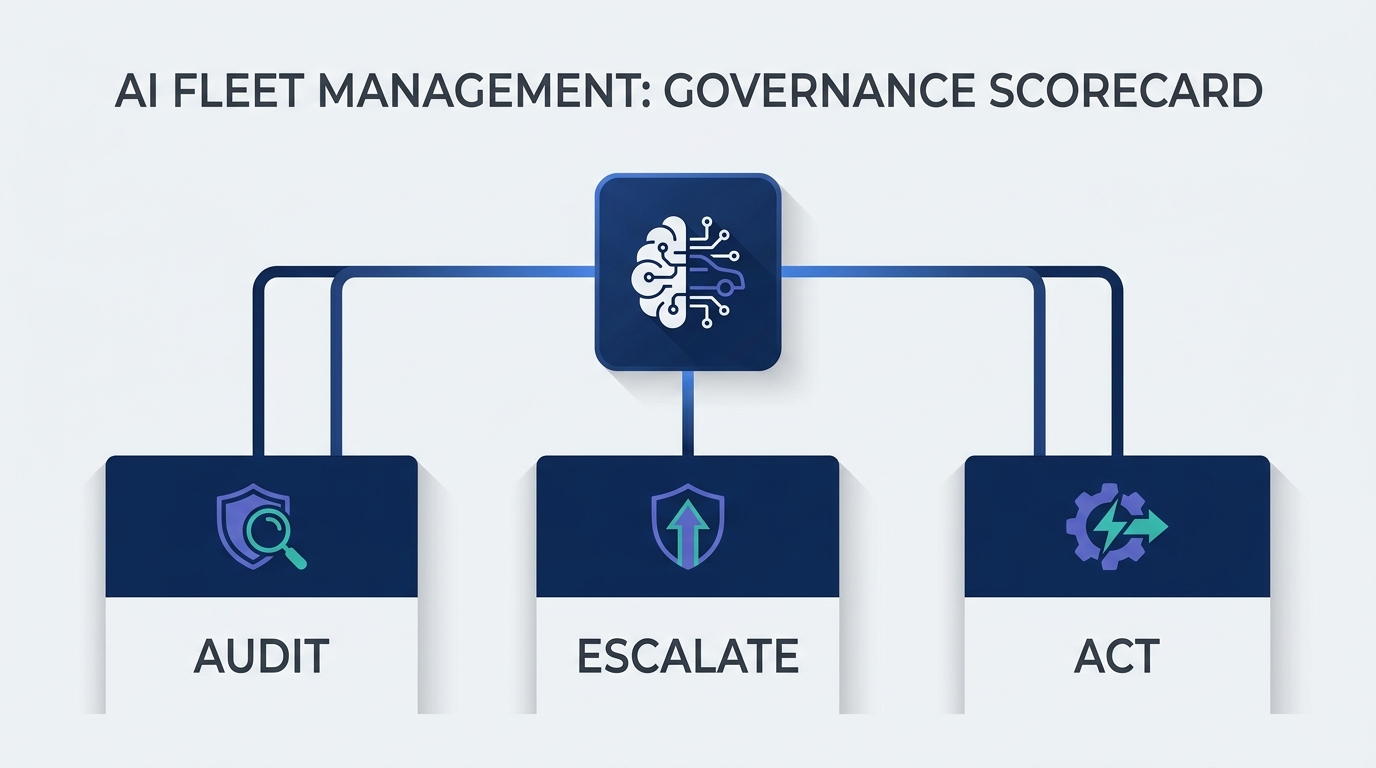
AI Fleet Management Vendor Scorecard
Use this as a quick buyer-screening checklist before a demo turns into a procurement project.
Ask
What exact workflow goes live first?
Strong answer
Specific workflow, owner, data sources, and success metric.
Red flag
Broad promises about autonomous fleet operations.
Ask
Which systems can the AI read from and write to?
Strong answer
Clear API/auth model and a fallback plan for messy systems.
Red flag
Hand-wavy integration language.
Ask
When does the AI ask for human approval?
Strong answer
Configurable thresholds and context-rich handoffs.
Red flag
Claims that no oversight is needed.
Ask
Can we see what happened and why?
Strong answer
Action logs, source context, and approver history.
Red flag
Black-box decisions.
Ask
Which operating metric improves?
Strong answer
Time-to-action, approval latency, downtime, or manual touches.
Red flag
Metrics focused only on AI usage.
If the vendor cannot explain the first workflow and the escalation model, the demo is ahead of the deployment reality.
Ask About the First Workflow
Do not start with a broad platform conversation. Ask: what exact workflow goes live first?
If the answer is vague, the implementation will be vague.
Ask About Integrations
Which systems can the AI read from and write to? How does it authenticate? Does it use APIs, browser automation, email parsing, or manual uploads? How are credentials secured?
Fleet operations depend on messy real-world systems. Integration details matter.
Ask About Escalation
What does the AI handle alone? What does it escalate? What context does the human receive? Can you change escalation thresholds over time?
Escalation design is the difference between useful automation and operational risk.
Ask About Auditability
Can you see what the AI did, why it did it, what data it used, and who approved the action?
If the system cannot produce an audit trail, it is not ready for serious operations.
Ask About Metrics
A vendor should be able to define the operational metrics before deployment:
- time-to-action
- approval latency
- vendor response time
- out-of-service duration
- manual touches per exception
- escalation rate
- reopened or recurring issues
If the only metric is "AI usage," keep looking.
The Right Way to Start
The best AI fleet deployments start narrow.
Pick one workflow with obvious pain. Define the current baseline. Deploy with human oversight. Measure improvement. Expand only after the workflow earns trust.
A good first deployment might be:
- maintenance approvals for estimates over a threshold
- vendor follow-up for out-of-service vehicles
- failed inspection routing
- dispatch exception coordination
- recurring fault investigation
Do not start with "AI-run fleet operations." Start with one expensive handoff.
Where OpFleet Fits
OpFleet deploys managed AI operators for business workflows. In fleet operations, that means an AI operator can sit on top of your existing systems and own a specific workflow: maintenance approvals, vendor coordination, return-to-service, or dispatch exception handling.
The point is not to replace Samsara, Motive, Geotab, Fleetio, or your ERP.
The point is to make the work between those systems move faster.
That is the practical version of AI fleet management software: not another dashboard, not a black-box autopilot, not a rip-and-replace operating system.
A governed AI operator assigned to a workflow, measured on time-to-action, with auditability, escalation, and humans in control.
AI Fleet Management Software FAQ
What is AI fleet management software?
AI fleet management software uses AI to detect exceptions, gather decision context, route next actions, automate follow-up, and identify recurring operational patterns across fleet systems.
Can AI replace fleet managers?
Not for serious operations. AI is best used as an operator that handles routine coordination, packages decisions, follows up consistently, and escalates judgment calls to humans.
What are the best AI fleet management use cases?
The strongest use cases are maintenance approval routing, vendor coordination, return-to-service tracking, dispatch exception handling, and recurring issue analysis.
How should fleets start with AI?
Start with one expensive handoff, define the baseline metric, deploy with human oversight, and expand only after the workflow proves itself.
The Bottom Line
AI fleet management is real when it automates the coordination layer of fleet operations.
It is hype when it adds intelligence language to dashboards without changing how work gets done.
The winning deployments will be boring in the best way: one workflow, clear metrics, human oversight, measurable improvement, then expansion.
That is how AI becomes operational infrastructure instead of another experiment.
Want to test where AI belongs in your fleet operation? Start with one workflow assessment →