Fleet Maintenance Approval Workflow: The Hidden Uptime Bottleneck
Maintenance software tracks the work. The bigger uptime gains often hide in the approval, vendor, dispatch, and return-to-service workflow around the repair.
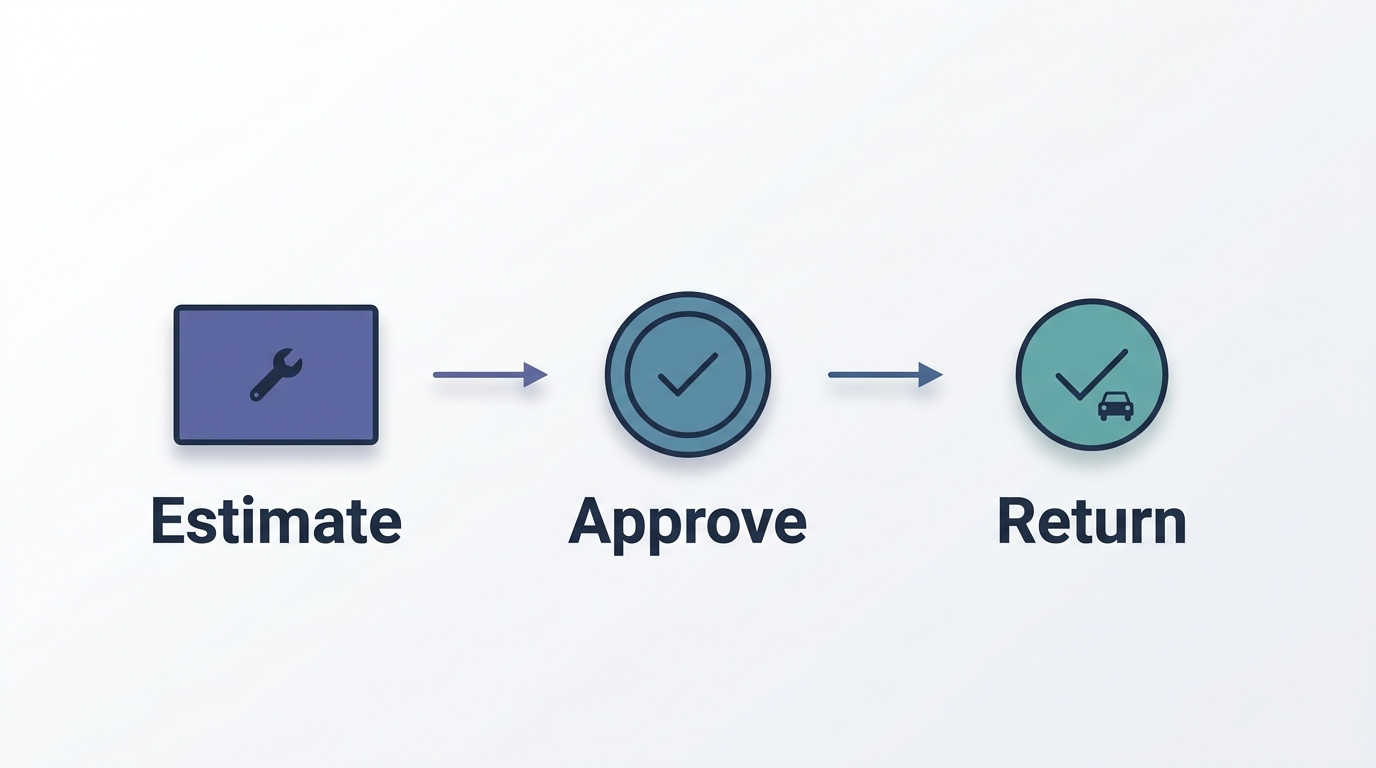
Fleet maintenance problems are rarely just maintenance problems.
A vehicle goes down. A vendor sends an estimate. Someone has to decide whether the repair is approved. Dispatch needs to know if the vehicle will be available. Finance may need context. The driver needs an update. Operations needs to understand customer impact. The vendor needs a response. Then someone has to confirm the work is complete and the vehicle is back in service.
Maintenance software tracks part of this. Sometimes it tracks a lot of it.
But the expensive delays often happen around the maintenance record, not inside it.
That is why the fleet maintenance approval workflow is such a good starting point for automation — and one of the clearest examples of broader fleet workflow automation.
Why Maintenance Approval Is a Workflow Problem
Approvals are deceptively simple.
A repair is either approved or not. The estimate is either acceptable or not. The vehicle either returns to service or it does not.
In practice, every approval carries context:
- Is this repair safety-critical?
- Has this asset had the same issue before?
- Is the vehicle needed for a committed route?
- Is the estimate above the approval threshold?
- Is the vendor preferred, approved, or underperforming?
- Is the repair covered by warranty?
- Would deferring the repair create higher downtime later?
- Does dispatch have a backup plan?
If the approver has to gather that context manually, the approval slows down. If the approval slows down, the vendor waits. If the vendor waits, the vehicle waits. If the vehicle waits, dispatch works around uncertainty.
The approval itself may take 90 seconds. The workflow around the approval can take days.
The Manual Approval Loop
A typical manual loop looks like this:
- Driver reports an issue or a system flags a fault.
- Vehicle is inspected or sent to a vendor.
- Vendor sends an estimate by email or portal.
- Fleet manager checks service history and urgency.
- Someone asks whether the vehicle is needed for upcoming work.
- Finance or operations reviews the spend if it crosses a threshold.
- Vendor gets approval or more questions.
- Repair starts.
- Someone follows up for status.
- Dispatch gets updated, sometimes late.
- Vehicle returns to service.
- Work order is closed, sometimes after the fact.
No single step is complicated. The chain is the problem.
Every handoff creates latency. Every missing piece of context creates another message. Every unclear owner creates drift.
What Good Approval Automation Looks Like
Good automation does not remove human judgment. It removes the manual drag around human judgment.
A strong fleet maintenance approval workflow should do five things.
1. Package the Decision
When an approval request appears, the operator should gather the relevant context before asking for a decision.
That package should include:
- asset details
- current status
- vendor estimate
- repair category
- estimated downtime
- service history
- repeat issue flags
- warranty or contract notes
- policy threshold
- dispatch impact
- recommended decision or escalation path
The approver should not have to search three systems and two inboxes before deciding.
2. Route to the Right Owner
Not every repair needs the same approver.
A $300 routine repair should not follow the same path as a $6,000 repair on a critical asset. A safety issue should not wait behind cosmetic work. A repeated failure should route differently from a one-off replacement.
Approval routing should reflect rules: spend thresholds, asset criticality, safety category, vendor status, and operational impact.
A Simple Fleet Repair Approval Matrix
Routine maintenance work order approval
Threshold: Under $500
Approver: Maintenance lead
Escalate: Repeat issue within 90 days
Dispatch: Notify only if route capacity changes
Standard fleet repair approval
Threshold: $500-$2,500
Approver: Fleet manager
Escalate: Vehicle needed within 24 hours
Dispatch: Notify when ETA changes
Major repair
Threshold: $2,500-$7,500
Approver: Operations or finance leader
Escalate: Estimate exceeds asset policy or vendor risk flag
Dispatch: Notify dispatch and operations immediately
Safety-critical repair
Threshold: Any amount
Approver: Fleet manager, with safety escalation if needed
Escalate: Vehicle cannot operate safely
Dispatch: Mark unavailable until return-to-service confirmed
Repeat repair or disputed estimate
Threshold: Any amount
Approver: Fleet manager plus vendor review
Escalate: Same component or vendor issue repeats
Dispatch: Notify if downtime extends past current plan
The exact fleet repair approval thresholds will vary by business, but the structure matters. Automation works best when the repair approval process is explicit enough to route consistently.
3. Keep the Vendor Moving
Vendors are often waiting for answers.
An automated workflow can acknowledge the estimate, request missing details, send approved work back to the vendor, ask for ETAs, and chase updates when promised milestones slip.
The point is not to annoy vendors with automation. The point is to make the communication reliable.
4. Keep Dispatch Informed
Maintenance and dispatch should not operate in separate realities.
If a vehicle is likely to miss tomorrow's route, dispatch needs to know before tomorrow. If a vendor confirms return-to-service by 3 PM, dispatch should see that update. If a repair is delayed, the downstream plan should change early.
Approval workflow automation should include operational communication, not just maintenance administration.
5. Enforce Closure
The workflow is not done when the repair is approved.
It is done when the vehicle is back in service, the work order is closed, the vendor status is updated, the right teams are notified, and any recurring issue is flagged for review.
Closure is where many manual processes leak value.
The Role of an AI Fleet Operator
An AI fleet operator can own the approval workflow without owning every decision.
It monitors incoming repair requests, gathers context, routes approvals, follows up with vendors, updates stakeholders, and escalates when the workflow is stuck.
A typical approval might work like this:
Vendor estimate received: $1,850 brake repair for Vehicle 42.
The operator checks the asset profile, service history, failed inspection note, route schedule, vendor record, and approval policy. It sees that the repair is safety-related, below the manager threshold, and blocks a route scheduled tomorrow morning.
It sends the fleet manager a concise decision brief: approve recommended, safety-related, route impact tomorrow, vendor ETA 24 hours after approval, no warranty coverage found.
The manager approves.
The operator sends approval to the vendor, asks for confirmed ETA, updates dispatch that Vehicle 42 is expected back tomorrow afternoon, and creates a follow-up reminder if the vendor does not respond by 2 PM.
That is not full autonomy. It is managed execution.
What to Measure
Maintenance approval automation should be measured against operational outcomes.
Start with these:
- Estimate received to approval decision
- Approval decision to vendor confirmation
- Vendor confirmation to repair start
- Repair start to return-to-service
- Number of follow-up messages per repair
- Number of stale approvals
- Number of out-of-service vehicles with unclear ETA
- Dispatch changes caused by late maintenance updates
- Repeat repairs by vehicle, vendor, or component
The metric that usually matters most is approval latency. If you reduce approval latency, you often reduce total downtime.
Where Maintenance Software Ends and Workflow Automation Begins
Maintenance platforms are valuable. They track work orders, service schedules, inspections, assets, parts, and maintenance history. For many fleets, they are necessary infrastructure.
But a maintenance platform does not automatically solve every cross-functional handoff.
The workflow around the repair may still involve:
- email threads with vendors
- finance approval rules
- dispatch impact
- driver communication
- customer commitments
- leadership escalation
- ERP or payment systems
- spreadsheets used for special cases
That is where a workflow layer helps.
It does not replace the maintenance system. It connects the maintenance event to the operational response.
How to Start Without Overbuilding
Do not automate every maintenance process at once.
Start with one approval category. For example:
- all vendor estimates over $500
- all safety-related repairs
- all out-of-service vehicles
- all repeat repairs within 90 days
- all repairs affecting next-day dispatch capacity
Define the baseline. How long does approval take today? How many handoffs are involved? How often does dispatch learn late? How many vendor updates require manual chasing?
Then deploy automation with human approval in the loop.
The first goal is not autonomy. The first goal is consistency.
Common Mistakes
Automating Without Policy
If approval rules are tribal knowledge, automation will expose that quickly. Write down thresholds, escalation paths, vendor preferences, and safety categories before trying to automate them.
Ignoring Dispatch
A maintenance workflow that does not communicate with dispatch is incomplete. Uptime is not just a shop metric. It is an operations metric.
Measuring Activity Instead of Delay
Do not measure how many automated messages were sent. Measure whether vehicles returned to service faster and whether fewer issues got stuck.
Trying to Remove Humans Too Early
Approval decisions often require judgment. Keep humans in the loop until the workflow earns trust. Automation should make human decisions faster and better informed before it makes them less frequent.
Where OpFleet Fits
OpFleet deploys managed AI operators for operational workflows. For fleet maintenance, the first operator can own the approval brief, vendor ETA follow-up, dispatch update, and closure loop.
It works with the systems you already use. It gathers context, routes decisions, follows up, updates stakeholders, and tracks closure.
The fleet manager stays in control. The operator handles the operational drag.
That is the practical path to better uptime: not a giant replacement project, not a vague AI dashboard, and not an unrealistic promise that maintenance can run itself.
One workflow. Faster decisions. Cleaner handoffs. Fewer vehicles stuck waiting on the next action.
Fleet Maintenance Approval Workflow Checklist
Before automating, make sure the workflow defines:
- Which maintenance work order approvals require human review
- Repair approval thresholds by amount, asset class, and safety category
- Who approves routine repairs, major repairs, and exceptions
- When dispatch gets notified about downtime or ETA changes
- Which vendor updates should trigger reminders or escalation
- What counts as return-to-service closure
- Which repeat repairs require deeper review
If those rules are clear, an AI operator can move the workflow faster without hiding the judgment calls.
Fleet Maintenance Approval FAQ
What is a fleet maintenance approval workflow?
A fleet maintenance approval workflow is the process for reviewing repair requests, routing decisions to the right owner, notifying vendors and dispatch, and tracking the vehicle through return-to-service.
How do you reduce repair approval latency?
Package the decision context before asking for approval: estimate, service history, warranty notes, dispatch impact, spend threshold, and recommended escalation path. Then automate vendor follow-up after the decision.
Which maintenance approvals should be automated first?
Start with high-volume, measurable categories: vendor estimates over a fixed threshold, safety-related repairs, out-of-service vehicles, repeat repairs, or repairs affecting next-day dispatch capacity.
The Bottom Line
Fleet maintenance approval is one of the best places to start with AI automation because the pain is concrete and the impact is measurable.
If your vehicles are waiting on decisions, vendors are waiting on answers, or dispatch is waiting on maintenance updates, the approval workflow is costing more than it looks.
Fix that first.
Want to map your maintenance approval workflow? Start with an OpFleet workflow assessment →