Best Fleet Management Software: The Missing Workflow Layer
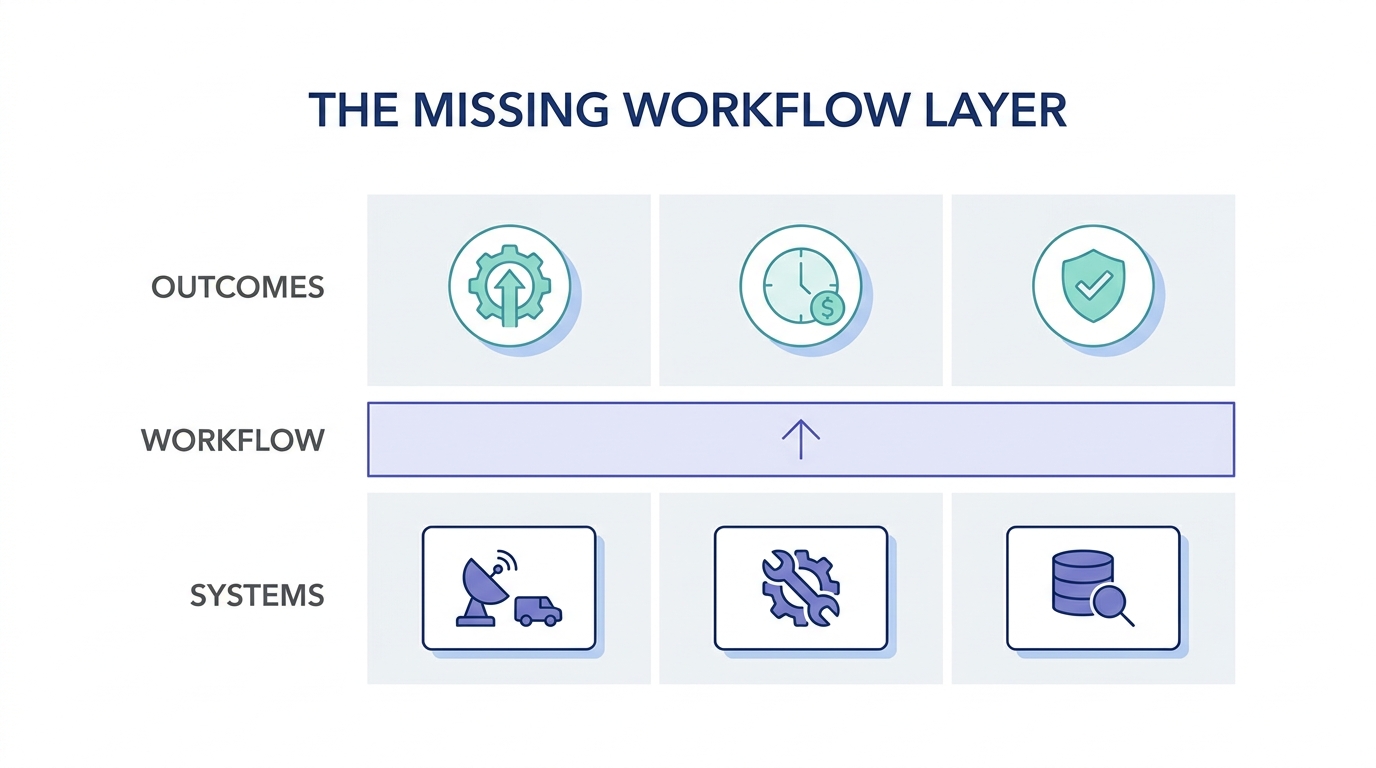
Samsara, Motive, Geotab, Powerfleet, Fleetio, Carma, and Flott HQ all solve important parts of fleet operations. The remaining gap is the workflow layer between systems.
The phrase "best fleet management software" sounds like it should have one answer.
It does not.
A local delivery fleet, a national trucking operator, a construction equipment business, a field-service organization, and a maintenance-heavy municipal fleet all need different things. Some need telematics depth. Some need safety. Some need maintenance. Some need asset intelligence. Some need better dispatch coordination. Some need fewer approvals stuck in email.
That is why the fleet software market is crowded. Samsara, Motive, Geotab, Powerfleet, Fleetio, Carma, Flott HQ, and dozens of others all make sense from different angles.
The real question is not "which fleet platform is best?"
The better question is: what job are you hiring the software to do?
How We Evaluate Fleet Management Software
The best fleet management software depends on the operational constraint. We evaluate platforms across five questions:
- Signal quality: Does the system capture the location, diagnostic, safety, maintenance, or utilization data the team needs?
- Workflow coverage: Does it move the next action forward, or only show the issue?
- Integration fit: Can it work with the systems the fleet already uses?
- Operational specificity: Does it solve a concrete workflow, or stay at the level of generic visibility?
- Adoption friction: Does it require a full replacement project before value shows up?
That lens separates telematics platforms, maintenance systems, data layers, and AI workflow operators.
Fleet Management Software Comparison
Samsara
Best for: Connected operations and telematics.
Core strength: Hardware depth, GPS tracking, diagnostics, safety, broad visibility.
Workflow gap: Turning alerts into routed approvals and follow-through.
Motive
Best for: Integrated fleet, safety, spend, and workforce operations.
Core strength: Broad suite consolidation with AI-forward positioning.
Workflow gap: Making the first workflow wedge concrete enough to prove ROI.
Geotab
Best for: Large fleets needing open telematics and ecosystem depth.
Core strength: Extensibility, data platform credibility, partner ecosystem.
Workflow gap: Assigning ownership and action across teams after insights appear.
Powerfleet
Best for: Multi-asset enterprise operations.
Core strength: Unified AIoT asset intelligence and cross-asset visibility.
Workflow gap: Moving from one pane of glass to completed handoffs.
Fleetio
Best for: Maintenance management.
Core strength: PMs, inspections, work orders, parts, and service history.
Workflow gap: Approval routing, vendor coordination, dispatch impact, closure.
Carma
Best for: AI-native fleet operating system.
Core strength: Bold automation and replacement-style operating model.
Workflow gap: Adoption friction if the team needs to prove value on top of the current stack first.
Flott HQ
Best for: Fleet data enrichment and operational intelligence.
Core strength: Connecting fragmented fleet data and surfacing exceptions.
Workflow gap: Enforcing ownership, decisions, and follow-through after data is enriched.
OpFleet
Best for: AI workflow execution layer.
Core strength: Works on top of existing systems to automate handoffs, approvals, follow-up, and escalation.
Workflow gap: Not a replacement for core telematics or maintenance systems.
Other fleet tools such as Verizon Connect, Azuga, Lytx, Teletrac Navman, AUTOsist, and Simply Fleet can also be strong fits depending on fleet size, safety needs, and maintenance depth. The same question still applies: do you need better signal, better records, or faster workflow execution?
Best For: Fleet Software by Use Case
- Best for telematics visibility: Samsara, Motive, Geotab, Verizon Connect, Teletrac Navman
- Best for driver safety and video telematics: Samsara, Motive, Lytx
- Best for maintenance management: Fleetio, AUTOsist, Simply Fleet
- Best for complex asset intelligence: Powerfleet, Geotab
- Best for AI-native fleet operations: Carma, Flott HQ
- Best for AI workflow execution on top of the current stack: OpFleet
If your team lacks visibility, start with telematics. If maintenance records are the mess, start with maintenance software. If the signal already exists but the next action is slow, start with fleet workflow automation.
The Fleet Software Market Splits Into Three Categories
Most fleet management software falls into three broad categories.
1. Incumbent Operating Platforms
Samsara, Motive, Geotab, and Powerfleet sit in this group.
They are strongest when the buyer wants visibility, telematics, safety, asset tracking, diagnostics, routing, utilization, compliance, and broad operational coverage. They often become core infrastructure for fleet teams.
These platforms answer questions like:
- Where are my vehicles?
- How are my drivers performing?
- Which assets are being used?
- What fault codes or safety events are happening?
- How do I consolidate more operational data?
This category is valuable because fleet operations need reliable signal collection. You cannot automate work you cannot see.
But visibility is not the same as execution.
2. Maintenance-First Tools
Fleetio is the clearest example here.
Maintenance-first tools win because the pain is specific. PM schedules, inspections, work orders, parts, service history, issue resolution, and uptime are easy to understand and easy to tie to ROI.
These platforms answer questions like:
- Which vehicles need service?
- Which work orders are open?
- What inspections failed?
- What parts or vendors are involved?
- How do we reduce downtime?
For many fleets, this is the right starting point. Maintenance is where cost, safety, and operational capacity collide.
The gap appears when the maintenance issue becomes a cross-functional workflow: approval routing, vendor follow-up, dispatch impact, finance context, and return-to-service communication.
3. AI-Native Orchestration Players
Carma and Flott HQ represent the newer AI-native motion.
They use language around AI operating systems, enriched fleet data, automation, operational exceptions, vendor coordination, and workflow intelligence. The story is more modern and more ambitious than traditional fleet software.
These platforms answer questions like:
- How do we automate decisions across the fleet stack?
- How do we connect fragmented data?
- How do we reduce manual coordination?
- How do we build an AI-first operating model?
This category points in the right direction. The risk is scope. Broad AI operating system promises can create adoption friction if the buyer is not ready to replace existing systems or redesign large parts of the operation.
Where Each Major Platform Feels Strong
This is not a teardown for the sake of tearing down. Most of these products are strong at what they were built to do.
Samsara
Samsara is a safe default for connected operations. It is strong in GPS tracking, diagnostics, routing, safety, and broad operational visibility. For mid-market and enterprise fleets, the brand trust and hardware depth matter.
Where Samsara is strongest: visibility and connected operations infrastructure.
Where the workflow gap remains: what happens after an alert or exception appears and multiple teams need to act.
Motive
Motive has a strong integrated-suite story. It combines fleet management, safety, spend, equipment, workforce, and AI-heavy positioning into a broad operations platform.
Where Motive is strongest: all-in-one operations consolidation with modern AI language.
Where the workflow gap remains: the first ROI wedge can get less concrete when the suite story becomes too broad.
Geotab
Geotab is strong as an open telematics platform with ecosystem depth. Large and complex fleets often care about extensibility, integrations, analytics, and long operating history.
Where Geotab is strongest: data platform credibility and telematics ecosystem.
Where the workflow gap remains: turning data and insights into owned action across teams.
Powerfleet
Powerfleet leans into unified AIoT and asset intelligence across fleet, warehouse, and industrial operations. The pitch is one system of record, one pane of glass, and unified operational visibility.
Where Powerfleet is strongest: enterprise asset intelligence across complex operations.
Where the workflow gap remains: visibility does not automatically resolve handoffs, approvals, and follow-through.
Fleetio
Fleetio is easy to understand because maintenance pain is easy to understand. PMs, work orders, inspections, parts, and issue resolution are concrete operational problems.
Where Fleetio is strongest: maintenance management and uptime workflows.
Where the workflow gap remains: the broader cross-functional process around the maintenance issue — approvals, vendor coordination, dispatch impact, finance, and operational closure.
Carma
Carma is pushing a bold AI operating system narrative for modern fleets, especially around maintenance-heavy use cases, vendor portals, approval thresholds, service verification, and autonomous scheduling.
Where Carma is strongest: ambitious AI-native replacement story.
Where the workflow gap remains: replacement-style promises can raise adoption friction for fleets that need to prove ROI before changing the stack.
Flott HQ
Flott HQ is strong on fleet data enrichment, fragmented system connection, operational exceptions, bottlenecks, dwell, queue time, billing accuracy, and customizable use cases.
Where Flott HQ is strongest: making fragmented fleet data more complete and operationally useful.
Where the workflow gap remains: enriched data still needs clear ownership, routed decisions, and enforced follow-through.
The Missing Layer: Workflow Execution
The market has plenty of tools that show, store, enrich, or analyze fleet data.
What many fleets still lack is a workflow execution layer.
A workflow layer sits on top of the existing stack and asks:
- What happened?
- Who owns the next step?
- What context do they need?
- What decision is required?
- What follow-up should happen automatically?
- When should the issue escalate?
- How do we know it actually closed?
This is the work that often leaks into email, spreadsheets, phone calls, Slack threads, and informal team memory.
That leakage is expensive. Not because people are lazy. Because fleet operations are exception-heavy, and exceptions do not respect system boundaries.
Why "Rip and Replace" Is Usually the Wrong First Move
Some AI-native fleet platforms tell a replacement story: stop using your legacy stack and move to an AI-first operating system.
That may be right for some teams eventually. It is usually not the right first step.
Most fleets already have sunk cost, trained users, integrations, reporting workflows, and internal trust around existing systems. Even if those systems are imperfect, replacing them creates risk before proving value.
A lower-friction path is to start with one painful workflow on top of the current stack.
Examples:
- Vendor estimate approval
- Out-of-service return-to-service tracking
- Failed inspection follow-up
- Dispatch exception routing
- Maintenance spend escalation
- Recurring fault investigation
The goal is not to prove that every system should be replaced. The goal is to prove that one expensive handoff can move faster.
How to Choose the Right Fleet Software
Use this decision framework.
Choose a Telematics or Operating Platform When You Need Signal
If you do not have reliable visibility into location, diagnostics, utilization, safety events, or asset status, start there.
You cannot improve what you cannot see. Platforms like Samsara, Motive, Geotab, and Powerfleet are built for that foundation.
Choose Maintenance Software When Uptime Is the Core Problem
If the biggest pain is PM compliance, inspections, work orders, parts, service records, and repair tracking, maintenance-first software is the right category.
Fleetio and similar platforms make sense when the work is primarily maintenance management.
Choose AI Workflow Automation When the Signal Exists but Action Is Slow
If your team already sees the issues but still loses time in approvals, handoffs, vendor coordination, dispatch communication, and follow-through, the problem is workflow execution.
That is where an AI operator is useful. See the practical guide to AI fleet management software for the evaluation criteria.
It does not replace the signal systems. It makes the work after the signal faster.
The Questions to Ask Before Buying
Before you buy or replace fleet software, ask these questions:
- Are we missing visibility, or are we slow to act on visibility we already have?
- Which workflow creates the most delay: maintenance, dispatch, vendor coordination, finance, or customer communication?
- How many manual touches happen between alert and resolution?
- Where do approvals get stuck?
- Which exceptions cross more than one team?
- What data already exists but is not used at the moment of decision?
- Do we need a new system of record or a better action layer across existing systems?
The answers will tell you whether you need a platform, a maintenance tool, a data layer, or a workflow operator.
Where OpFleet Fits
OpFleet is not trying to be a better telematics platform than Samsara, Motive, or Geotab. It is not trying to be a broader system of record than Powerfleet. It is not trying to replace every maintenance workflow that Fleetio handles well.
OpFleet is built for the work between systems.
The best fit is a fleet with 25-250 vehicles, a lean operations team, a messy but functional stack, and visible coordination drag.
The first deployment should be narrow. If maintenance is the clearest pain, start with the fleet maintenance approval workflow:
- Maintenance approval and vendor coordination
- Out-of-service return-to-service workflow
- Dispatch and back-office exception handling
Start with one. Measure time-to-action. Keep humans in control. Expand once the workflow proves itself.
Fleet Management Software FAQ
What is the best fleet management software?
The best fleet management software depends on the job. Choose telematics software when you need better visibility, maintenance software when service workflows are the bottleneck, and workflow automation when your team already sees the issue but action is slow.
What is the difference between fleet management software and fleet maintenance software?
Fleet management software usually covers broader operations such as telematics, safety, routing, utilization, compliance, and asset tracking. Fleet maintenance software focuses on PMs, inspections, work orders, repairs, parts, and uptime.
When do you need workflow automation instead of another fleet platform?
You need workflow automation when alerts, records, and dashboards already exist, but approvals, vendor coordination, dispatch updates, and return-to-service follow-through still happen manually.
Who should choose OpFleet?
OpFleet is a strong fit for fleets with 25-250 vehicles, lean operations teams, existing systems they do not want to rip out, and obvious handoff pain between maintenance, dispatch, vendors, finance, and operations.
When should you not choose OpFleet?
Do not start with OpFleet if you lack basic fleet visibility or maintenance records. Fix the signal or system-of-record problem first, then automate the workflow around it.
The Bottom Line
The best fleet management software is the one that solves the next constraint in your operation.
If you lack visibility, buy visibility. If maintenance records are chaos, fix maintenance. If data is fragmented, enrich the data.
But if your team already knows what is happening and still spends too much time getting the next action done, you do not need another dashboard.
You need a workflow layer.
That is the opening for AI operators in fleet operations: not more hype, not more screens, not a heroic rip-and-replace project.
Just faster decisions, cleaner handoffs, and fewer expensive exceptions stuck between people and systems.